Blinded by the Light

I didn’t choose that title for another of my articles in the Christmas issue of New York Moves magazine, but that’s what they named it. Several editorial changes were made, to which I objected noisily, but I included the piece in unmutated form here:

Both the faithful and the cynical complain a lot around the holidays. The faithful, that commercialism has debased the original spiritual purpose of Christmas, and the cynical, that we continue to pay lip service to this debased spiritual purpose. I for one have grown bored with both sides as hopelessly unfamiliar with human nature, objecting as though it’s news that we gravitate toward the material rather than the spiritual, and then try to make ourselves feel less crass by attaching a lot of Hallmark platitudes to our materialism. Of course we do.

My complaint is more specific, involving the reason I believe the spiritual aspects of Christmas, or, really, the trappings of any religion, are ignored so easily in the first place. From a literary point of view the stories of the world’s religions are some of the most astonishing ever imagined: in them are heroes and antagonists, obstacles, magic (for that’s really what a “miracle” is, isn’t it?), and distinctive moral themes from which one may learn how to live. To take Christianity in particular, in addition to the blockbuster spectacles of the Old Testament, the New Testament features the peculiar story of a tri-partite god who arranges for his son/self to take human form through virgin birth, and preach to those who’d listen a new and, at the time, completely innovative ideology. He foresees (and if one takes the “Judas Texts” into account, hand-picks and instructs his traitor), and sets into motion his own gory death whereby, through some mystical magic, the sins of mankind are purged. In this moment of his assuming the world’s evils, the earth darkens as god, the father, cannot look on such impurity, and in his dying moments god, the son, cries out at his abandonment. He then rises from the tomb and, before ascending to heaven, promises to return “in the blink of an eye.” Thus is man saved from his mortality.

This story shouldn’t leave me cold.

The problem for me is that this story has been told to me in so many dumbed-down forms over the years, starting the first day of kindergarten at a ghetto Baptist school in San Francisco, it has become part of the mere noise of my past, like the Sesame Street theme song or the emergency siren test that blasted through the city every Tuesday at noon. Every Monday and Wednesday morning at my elementary school, we convened in the chapel to listen to a sermon given not by an ordained minister, but by one of our teachers or the school’s pious headmaster. These often involved badly-painted placards illustrating some de-sexed episode from the Old Testament, or a bloodless version of the story of Golgotha. These were followed by their imploring us to “accept Jesus into our hearts” so that we may receive “salvation.” Imagine what this could mean to a seven year old. I actually envisioned a tiny Jesus, complete with curly hair, beard, white robes, and melancholy face, grasping onto nearby arteries while curled into one of the cramped chambers of my heart, blood sloshing about his sandals, his head bumping against the wall as it pumped. I worried he’d stumble out when I played on the swings. “Accept Jesus into your heart” was such a regular theme that I really can’t remember any of the other specifics of this brainwashing, but I do remember shyly asking my parents before they put me to bed one night if they would “accept Jesus into their hearts” so that they could go to heaven, and then, perceiving a lack of seriousness in their response, worrying all night over the fate of their souls in the afterlife. Which of course made me think on the possibility of their deaths. Which made me even more miserable.

For what was all this propaganda? How could they fail to see that an unripe mind cannot but reduce this majestic doctrine to absurdity?

More importantly, how could they fail to see that the doctrine would not only be lost on us at that age, but that our over-exposure to it would numb us against any power it might have had once we were mentally and spiritually ready for it later?

In A Return to Modesty, Wendy Shalit argues against the trend to teach sex-ed at a younger and younger age (which is purportedly done in an effort to beat the long arm of the sex-focused media to the punch), claiming that to introduce the details of the subject to a mind before the interest in it has arisen naturally has a warping, rather than educative, effect. Having learned the specifics myself long before I stopped believing in “coodies,” I’m inclined to agree with Shalit. I’d argue the same principle applies to religion.

At my school, as at any parochial school which includes religious inculcation as part of its agenda, we were fed some very grand and complex ideas, but before we had reached an age, or a state of mind-readiness, when it would have been possible for us to perceive the grandeur or even to perceive the complexity of those ideas (hence my imagined travel-sized Jesus). These ideas became “old hat” long before it ever occurred to us to ask what it really means that god died on a cross, or that this is in fact a supernaturally outrageous and heavy concept that should baffle, terrify, shock, and excite us. By exposing and over-exposing us to concepts unsuited in every way to our lack of maturity, they robbed us of the opportunity to be baffled, terrified, shocked, or excited by them then or later. The insult to injury is that their one concession to our unreadiness was in the anemic, baby-talk dilutions of these concepts they fed us. Not the Confessions of St. Augustine, but the Jesus is my Homie rap, undid me as a believer.

I’ll never forgive my elementary school for having wasted hours of my life filling my head with meaningless platitudes when I never did get a good grasp on long division. Or for the nights I spent crying into my pillow, envisioning my heathen parents unsaved and in flames. I am tired of the faithful and the cynical, and all their whining about the desecration of Christmas. These complainers seem to think that the thing that has been desecrated is the holiday itself, and our cheerful desecration of it, a symptom of some cultural disease which only surfaces, herpes-like, once a year. The truth is, few of us could ever even dream of appreciating the sacredness of the ritual or the mystery of Christ’s story at all. It is our own minds that have been desecrated, befouled from infancy with the stale rhetoric of people more interested in turning us into congregation drones than in helping us cultivate what innate religiosity–indeed—true spirituality, we may possess. I suspect the natural spirituality of a human being is a delicate and ephemeral thing, easily killed by over-feeding or careless handling. My own was beaten numb; actually, it was bored to death. It is no surprise to me that at Christmastime we shop and eat and drink ourselves senseless, when for so many of us, the story of Christ occupies the same mental space as the tooth fairy, and the word of god is a bubble-gum jingle.


Posted in my neuroses, my pseudo-religiosity, Publishing rants | 1 Comment

In Defense of Vanity

I know, I know, I’ve been a bad, bad blogger, but I have a good excuse, which is that I’ve been spending all my time studying the art of classical acting and the thea-tah. Instead of dutifully keeping the world abreast of the ordinary horrors of my existence, I’ve been reading plays, scanning verse, enunciating, combatting a new and uncharacteristic stage-fright, and breathing in and out. The only thing other than course-related work I’ve done in the past few months has been writing for the magazine I’ve mentioned on this site before. So, now that some of the issues of New York Moves to which I’ve contributed have hit the press, I can replicate them for a geographically broader audience….. here’s one:

There’s a story from my babyhood that I often ask my mom to repeat, partly because it’s so damn cute, but mostly because it’s about me, and I like hearing stories starring me. She says that whenever I cried, she’d hold me, and I would angle myself to face the large antique mirror that hung on the door in our kitchen and then just watch my reflection as I cried. She’d have to hold me up in front of the glass for a good twenty minutes while I sniffled and sobbed until I started kicking her in the chest, which meant I was finished and now hungry. If I was in another room at the time of an upset, she’d pick me up, and I would twist and strain in her arms as she held me, and instead of the usual uninhibited wailing, my sobs had a hesitant, questioning quality–my perceptive mother would then carry me to my favorite spot in the kitchen where I’d finally let it all out “on camera.”

Even today I can’t resist checking myself out whenever I’m distraught. My face flushes so that my eyes look greener, my lips get red and puffy, the tears make my eyelashes all shiny and they stick together like a doll’s. But even better is how very soulful I look when I’m upset. I take advantage of my heightened state and perform Meryl Streep’s famous speech from Sophie’s Choice where she admits her father was an abusive Nazi abettor: I pretend the mirror is the window of Stingo’s Flatbush apartment, stare out into the imaginary Brooklyn dusk, cock my left brow, let a single tear roll down my cheek, and whisper, “…he said, ‘Zozia, your intelligence eez pulp………pulp!!…’” Or I pretend that JFK, Jr. and I are sitting in a coffeeshop in the Village and he’s breaking up with me because of insurmountable class differences or he can’t handle my Slavic temperament or maybe Caroline feels threatened by my libertine tendencies, and he’s really a homebody at heart after all. Tomorrow all the beauty of my pathos will be plastered across the Daily News and the Post. Single women all over New York will discuss the tragedy over cosmo’s after work, and the men will shake their heads and wonder how John-John could have let someone like me get away.

Yes, I spend a lot of time in front of the mirror. And not just crying, but toning, moisturizing, concealing, highlighting, powdering, SPF-ing, eyelash-combing, eyebrow-smoothing, and practicing smiles of varying degrees of toothiness. I’m currently trying to cultivate the ability to blush on command, very tricky indeed. I have spent thousands of dollars (in my lifetime, not like last week or anything) on hair removal, exercise classes, facials, not to mention clothing to accentuate all my favorite body parts. All to achieve that “I just rolled out of bed looking like this” look. Or better, that “I was born out of a giant seashell, locks a-flowing and heralded by naked baby angels” look.

I actually went to school with someone who laid legitimate claim to the natural Venus look: her name was Rafaella (how apt), and she had long blonde hair that curled and shone even though she washed it with pine tar soap. She never wore makeup and didn’t need to, as her skin was clear and her cheeks and lips naturally pink. No matter how little sleep she got, she never had dark circles under her eyes. She never bothered shaving, but why would she, with legs sprinkled with a soft down, invisible except when sparkling golden in the sun. I never saw her exercise, yet her legs were those of a dancer, without the duck-like turn-out. She never wore a bra, explaining that her C-cups were too small to need one (a thousand times, damn her). The ace up my sleeve is that since she’s too much of a hippie to moisturize or use sunscreen, the harsh New Mexico sun will dry her up like a yellow raisin by the time she’s 35. Hoorah!

Rafi was indeed the campus Venus, sort of a paradigm for unfussy hotness. Something bothered me, though, when people spoke of her, and despite the case I just made for my own monstrous and complicated vanity, it wasn’t quite competitiveness or jealousy, although I will understand if my reader thinks I’m a lying liar. When people discussed the Hotness of Queen Rafi, what they focused on almost more than her hotness itself was her seeming obliviousness to it: more than her actual beauty, it was her utter lack of vanity about it that most impressed people. “She’s so gorgeous, and she doesn’t even know it…” I couldn’t put words to it at the time, but it was peoples’ admiration of Rafi’s unawareness of her assets that offended and troubled me.

This is how people spoke of Audrey Hepburn and Brigitte Bardot, and is usually part of the hype over any starlet newly minted by the studios and the magazines. Even Vogue, that juggernaut of our collective obsession with the superficial, in a recent spread on Keira Knightly, cites couture giantess Vera Wang as gushing “…to be so beautiful and yet to be so unaware of it I find incredibly modern.” Please, Vera, tell us more about modernity.

There are two reasons not to praise someone for lacking vanity.

We live in a world which makes an unprecedented racket about physical beauty and places all sorts of debilitating pressure on people, and especially on women, to conform to evermore minutely finicky and widely unrealistic standards of physical perfection. It is unfair and hypocritical to expect a woman to be oblivious to, let alone unworried by, her physical assets or defects. How sick and self-destructive is it for us to uphold morals in direct conflict with our own self-generated ethos?

Secondly, it is backward and sexist to praise a woman for lack of awareness of any kind. In our society, beauty is power. A woman aware of her beauty, whether god-given or self-cultivated, is actually aware of a weapon in her arsenal that, if she’s smart about it, she can employ to her advantage. Someone (it’s usually a man) who praises a woman for her obliviousness to this very powerful asset is actually admitting his relief that the woman is wasting a tool she could use to gain the upper hand (with him) or to get ahead in our image obsessed society. Praising lack of vanity, like praising innocence, is praising the inability to function fully in this world.

For this embargo on vanity to be anything but bogus and oppressive, our society must either shift its monomaniacal obsession with physical attractiveness or allow for a less exclusionary definition of beauty, And until I see leg hair, ass fat, and crow’s feet on the cover of Vogue (which in the new world will be a women’s literary-political-theological journal), I’m not buying it.

Posted in angry feminism, my neuroses, Publishing rants | 2 Comments

Another Rejected Article!

My magazine editor recently offered me the “Rant” section of the issue, basically free rein to, well, rant, on anything I choose. I wrote an article that he handed back to me, declining to publish it. Our conversation went thus:

Editor: There is no place in this magazine for something so narrow-minded, ill-informed, wrong-headed, depressing and depressive, untruthful–

Me: Why not?!?!

Editor: Prissy–

Me: Prissy only if you look at the world through pervert-colored glasses!!

Editor: Your readers will dismiss you as a frigid, frustrated suburban biddy–

Me: I’m OK with that!!

Editor: That is not what this magazine is about.

Me: BOLLOCKS IT’S NOT!!

Editor: Bollocks it is.

Me: (mo’ded silence)

Editor: (grins nefariouosly)

It reminded me a little of my conversations with the director at my old theatre:

Director: Larissa, I can’t cast you in (name of play)–

Me: Why the hell not?!

Director:–because you’re too/not enough (adjective) for the role of (proper name). Don’t worry; there will be parts that suit your (noun) more (adverb). (Proper name)’s audition was more/less (adjective) and she (verb)’s more (adverb) for the part.

Me: Like hell she is/does!!

Director: Don’t argue with me.

Me: (mo’ded weeping)

Director: (glowers nefariously)

Anyway, here I can publish the article in all its prissy glory. In your face, Conde Nast!
(or whoever owns the magazine)

I had an acquaintance for a while whom I didn’t know well, but who seemed worth getting to know—he had pretty red hair and was taller than I (which always grabs my attention-I don’t know why more men don’t try it), and had a relaxed arrogance that I should probably learn to read as a warning sign but haven’t yet. I was curious about him and pleased when he approached me at a recent party in the Village. But when he spoke, his intentions were so unappetizingly clear—so impersonally sex-driven –that out of abashment and instinctive non-whoriness I mentally aborted those embryonic “maybe” thoughts I had harbored for him and felt my loins frosting over as I waited for the barrage of come-ons to end. So unworried was he that his baldfaced bluntness was inappropriate, unappealing, or even downright repulsive to any woman who wasn’t a slipshod floozy, that when I declined, instead of rethinking his tactic and hazarding a different one, he demanded that I explain why I wasn’t interested. As flummoxed as I was at hearing that a one night stand with the likes of him or bloody-anyone should fill my heart with giddy joy or whatever, the second shock of being challenged to justify myself left me stunned. I should have slapped him, and only later did I realize how unfortunate it really was that I hadn’t slapped him, because there was a deeper insult I hadn’t articulated to myself in the moment: He not only thought I was the kind of person (slipshod floozy) who would respond to such crassness, but he felt he could say it to my face. Maybe the way I describe this incident makes the boy sound like some displaced macho freak from a David Mamet play, but I’d wager that his “strategy,” if you can call something so un-thought out and artless a strategy, is not so unusual. Every woman my age I know has endured similar interactions; I wouldn’t be surprised if a good number of girls a decade younger than I had as well. Now, men don’t make a habit of repeating maneuvers that don’t work for them, so I’ll venture that as depressing as it is to acknowledge it, many women fall for this lunkheaded vulgarity.

As a contrast, I’ll offer a short anecdote about my father: In the years following the second world war, he was laid up with TB at the veteran’s hospital in Waukesha, Wisconsin. Though not a misanthropist, he remained somewhat aloof from the other patients, whom he considered to be graceless Yankees. Instead of joining the other men in their regular entertainments: gambling, spitting, and harassing the nurses, he amused himself by resuming a practice his mother had taught him: tatting (a method of needlework used to create lace designs on the edges of fabric). This is not a skill most men learn these days, but in his time, and in the South, it was common for a mother to teach her son the same homemaking skills she taught her daughters. In any case, the nurses were disarmed by my father’s gentlemanly manners and impressed with his artistry, and soon started bringing him their knickers to be embellished. He’d get a plain pair of panties and return them trimmed with pink daisies. The other men, who at first had snickered at his practice of this womanish art, now realized that they had been outdone; for all their gropings and lunkheaded overtures, it was my father whose bed was perpetually flanked by a bevy of squealing, giggling nurses waving their silken underthings in delight. Southern charm had triumphed over Northern boorishness.

I began this article intending to extol the second manner of wooing I described, the artful over the obtuse, but then I realized that this would be akin to saying I want a man who will trick me out of my panties, and decided to reconsider. I am inclined to appreciate the gentleness of my father’s manner, not to mention the implied understanding that a woman must be too intelligent and classy to succumb to blunt propositioning (an understanding clearly lacked by that boy I should have slapped). And it angers me that there are so many men who need to be slapped, and so few women who will slap them. After all, the proper response to being objectified, underrated, and insulted is not to sleep with the offender (which must happen often enough to make it worth men’s while to continue to act this way), but to slap him down, yes?

But on second thought I see that it’s no better to surrender to the charming, artful, and subtle, than to the crude, brazen, and heavy-handed. Behind them both is the same coarse pragmatism that should be recognized for what it is: not a genuine interest in the woman as a human being and individual, but rather an undiscriminating quest for poon, however elegantly dressed. My artful father was not a lecher, but he could have been, and a very successful one. I suspect that the artless boy I regret not slapping is also a successful lecher.

Now my question is: Why is it that, whatever the current and local trends are for seducing women, whether they involve straightforwardness or dissembling, women can be counted on to respond positively to them? Who cares if a few hardheaded icequeens like me won’t stand for it? Men seduce on the principle of carpet-bombing: throw enough missiles and you’re bound to hit something. As I said before, enough women must respond to these techniques to give men reason to continue employing them. They sleep with men who have not given any convincing indication that they love or respect them, and then whine that the men they’re sleeping with don’t love or respect them. What else, besides shoes, was Sex and the City about?

Perhaps I am just more frustrated than my peers at the atmosphere between the sexes, which to me appears cluttered with miscarried intentions and run-down hopes. But even I am not entirely pessimistic. Something must work; people do fall in love and enjoy satisfying relationships, even if such sweet tales are spectacularly upstaged by epics of failure and regret. But regardless of how a romance turns out in the end, there are ways of approaching a woman initially which don’t insult her intelligence or outrage her class. I believe a woman can always tell, though she may be awash in denial about it, when a man is merely putting his boner on hold until he can come up with that perfect line which is the “Open Sesame” of her pants, and when he is speaking to her because he genuinely finds her interesting and might want her company for activities other than boning. It is to keep the terrible debilitating loneliness at bay that she will hold onto her denial even when her instinct tells her she’s being scammed. In Tennessee Williams’s brutal play Orpheus Descending, fallen belle Carol Cutrere explains why she sleeps with man after man despite the physical danger to her frame, too slight to survive childbearing, too slight even to endure the weight of a man without agony: ”The act of lovemaking is almost unbearably painful, and yet of course, I do bear it, because to not be alone, even for a few moments, is worth the pain and the danger.” Even a hardheaded icequeen (my editor adds, “prissy auto-didact”) can understand this choice, this lethal need to forget, however briefly, how alone we actually are. To silence that inner howling for intimacy we will go with the boorish propositioner or the eloquent playboy–will knowingly accept the ersatz for want of the genuine.…and as the howls rise up again, we feel ourselves turning into the bitter cynics we never believed we could be.

Or perhaps not. As much heartache as is out there, perhaps…….the devices one sex uses to get closer to the other aren’t really to blame, are rather just that, devices, not the substance of the problem. I guess it didn’t do me any more harm to be subjected to the artless boy’s blunt invitation than it did those nurses to loan their underwear to my skillful father. Such villainies seem rather twee compared to the disaster of a full-fledged, authentic love falling apart, the hopes of two vested people destroyed, which truly is the frightening thing.

Posted in angry feminism, Publishing rants | 16 Comments

To Whom it May Concern,

I am issuing a public plea, an appeal, if you will, to the hearts of my readers as a last humble effort to obtain the support I need to follow my dreams.

Sometimes I get a sneaking suspicion that acting is not a highly respected vocation. In fact, if my findings from my grant search are any indication, the world is actually more interested in finding a cure for cancer and promoting peace in the middle east than it is in cultivating the next generation of Shakespearean actors. Did you know that the Peace Corps has no theatrical division? And that you can’t get a deadline extension on the Fulbright?

When “philanthropists” like Warren Buffet and Bill Gates ignore my queries and Tony Hopkins won’t return my calls, I feel so hurt and confused by the lack of generosity in this world, I ask myself, “Where is the Love?”

Fifty thousand dollars seems so little to ask. What is it, a shiny new car? A downpayment on a house? Think of what you could be buying with your hard-earned money, if you stopped thinking about what the suburban middleclass bourgeois expected of you, and started thinking about what you expected of you…..

If I fail to inspire you, gentle readers, with the spirit of Giving, then for the length of my sojourn in London, I will have no choice but to eat conventionally-grown fruit, wash my face with tap water, and toil for 10-15 hours a week in some sweaty oppression inflicted by the school’s ministry of “Work!Study!” This will leave precious little time for Sloane-ing, coffeeshop blogging, or contemplation of The Beautiful. And from what I hear, the mines just don’t pay like they used to.

Imagine.

And do the right thing. Cash, personal checks, and applications for pre-nuptial divorce settlements gratefully accepted.

Sincerely, Larissa

Posted in London, theatre | 1 Comment

New York’s Historic Second Avenue Deli is Now a Chase Manhattan Bank.

…the very means by which oustanding success declines makes the process doubly destructive to cities….For some reason, banks, insurance companies and prestige offices are consistently the most voracious double destroyers in this way. Look to see where banks or insurance companies are clustered, and you will too often see where a center of diversity has been supplanted, a knoll of vitality leveled. You will see a place that is already a has-been or is becoming so.

The Death and Life of Great American Cities, Jane Jacobs

Posted in New York | Leave a comment

Britblog II

So, yes, I was in London for 10 days recently, where I auditioned and was accepted at the Central School for Speech and Drama for their MA program in classical acting. Woo-Hoo! In addition to my elation at the prospect of spending the next year immersed in the classics, after my short visit in London I realized that I had to attempt a longer stay and become more familiar with this great city.

When I made plans to stay in the home of a friend of mine and his flatmate, both bachelors, I envisioned a home decorated in the style of New York’s infamous Coyote Ugly bar: abandoned bras dangling from the ceiling fans, floors sticky with spilt booze, galaxies of dust and bodyhair hovering in the corridors and smeared boxerbriefs drooping off doorknobs. However, Brian and Marcus, old college buddies, live in a charming neighborhood in southeast London named Ladywell, on this picturesque street:

And they maintain a terrifying purity in their home. I’d wake up in the early morning to shouts of “ZERO TOLERANCE!” thundering from the kitchen and stumble in (trying not to slide to my death across the dustless hardwood floors) to find one of my hosts at the foaming kitchen sink, lathering furiously while the laundry washer trembled at his side. At first I thought “zero tolerance” was a warning to whichever flatmate was duty-bound at the moment to do the cleaning by the one who was currently off the hook, a “YOU FEAR HOGAN!!”- style reprimand for an AWOL dishwasher or bathtub scrubber or floor sweeper. But it is in fact a battle cry in the style of “WE ARE THE CHAMPIONS!”—a mantra by which the obligated revs himself up before a trying shift of degreasing. “ZERO TOLERANCE!” from Marcus washing dishes in the kitchen, “ZERO TOLERANCE!” from Brian scrubbing tiles in the lavvy. It was a virtual cacophony of hygiene. Not only were my prejudices about the bachelors debunked by the gleaming cleanliness or their home; I immediately felt an inner panic concerning my own slobbery in contrast. The idea of exposing my slovenliness and disgracing my country before these olympians was too humiliating and I could not rest peacefully for fear of allowing some disgusting habit of mine to surface in a moment of unawareness. What if I should accidentally leave my sneakers where somebody might smell them? Or get caught cleaning my mascara wand with my toothbrush? Or forget about all the snails I trampled on the stairs to the house and tread guts all over the living room carpet? For the entire time of my stay I obsessively picked my hair out of the drain after I showered, buried my soiled clothing in double plastic bags deep inside my suitcase, and wrapped the Q-tips I cleaned my ears with in tissue before I pushed them to the bottom of the rubbish bin. The potential for disaster was high and I had to remain vigilant. The only suggestion of squalor made by my hosts was the expanding stalagmitic array of empty liquor bottles on the kitchen floor surrounding the garbage can. And even that didn’t seem as filthy as it would in any major American city home, where each of those bottles, even those with but a drop of wine in the bottom, left overnight would by morning be stuffed with drowned roaches, drawn to their besotted doom by the pungent aroma of the pickling booze.

Anyway, the first night I was there, the night before my big audition at Central, Brian, a prominent acting teacher and director, and Marcus, owner of a talent agency, and I converged in the living room for a discussion on a life in the theatre.

Brian: “I hardly ever go to shows anymore. I’d much rather get a nice bottle of wine and watch Big Brother, any night.”

Marcus: “Or Top Gear. Top Gear’s better.”

B: “Right. Brilliant. I’ve no wish to sit in some uncomfortable middle-class chair surrounded by white people and watch a bunch of actors…acting…”

M: Well, it’s a defunct art form, isn’t it?”

B: “A dinosaur. Why go to a play if there’s a boxing match on?”

M: “I mean, if actors were pilots, and pilots were forced to wear their uniforms out, and you saw just how many bloody pilots there were, you’d say, ‘Why are we training so many bloody pilots? There are only so many planes.’ What’s your exit strategy, Larissa?”

L: (silent as I fight back tears)

B: “You definitely need an exit strategy. When you sit down with yourself and say, ‘I need to say goodbye to this’. For some guys it’s thirty-five, but for women it might need to be sooner– shorter shelf-life, yes?”

M: “Don’t get discouraged about this; it’s just important that you have a plan for what to do with your life in case you don’t make it…more wine?”

I’d like to discuss the British colloquial use of “brilliant,” which I find to be unfailingly entertaining and funny. In America, “brilliant” suggests a high degree of virtuosity exhibited in a work of art or idea (e.g.. Meryl Streep’s brilliant performance in Sophie’s Choice), or an exceptionally talented or skillful person (e.g. the brilliant painter Picasso), or sometimes an unusually bright color (as in my brilliant pink hat). We only veer away from the literal sense of the word by applying it to decidedly negative and unbrilliant things in a blunt and obvious version of sarcasm, as in “Whose brilliant idea was it to paint the door shut?” The British, on the other hand, seem to prefer to place the word somewhere in the middle, in reference to something they regard as positive and worthy of praise, but utterly unconnected to talent or skill in the fine arts or philosophy.

“They serve up a brilliant pig’s blood pudding at Maggie’s.”

or,

Jack: “Her dress just snapped off like a broken condom.”
Algernon: “Brilliant.”

I’m convinced this usage denotes a deeply cynical streak in the British character (which after a ten-day visit I feel completely justified to diagnose). They over-rate things normally understood to be of limited value as if to spit in the face of the higher things in life. “There is no real genius left in the world; the gods are dead, but bollocks to them, we’ve got pig’s blood!” Cynical or not, though, I still laugh whenever I hear “brilliant” used this way. Oh, and “bollocks,” too, every time.

I guess the most troubling thing about London was how very poor I was there. On the first day of my trip the exchange rate was two dollars to the pound and on subsequent days it hovered around $1.80-$1.88/pound. I’m used to being a rich American abroad and having to restrain my spending habits in order to discourage gypsy thieves and also not to appear overly vulgar and ugly—the “Ugly American”! Of course this happy illusion can only be upheld in countries crippled by poverty. In London, however, I had to pause before I ordered an $8 falafel sandwich or a $7 latte. A one-day three-zone travel card was $20; student tickets to the Gielgud Theatre were $30!! Although it killed my buzz not to be able to gorge myself at the most pretentious restaurants or use the loose change at the bottom of my purse to fill my suitcase with precious national treasures, I did enjoy the unfamiliar feeling of self-pity brought on by my newfound destitution. I pretended I was in one of those movies where Julia Roberts or Jennifer Lopez lives a ho-hum working-class life while dreaming of the big time and then is rescued by a handsome and mysterious millionaire with grey hair, to become the jewel in the crown of the upper class while never forgetting her roots. I stood outside Harrod’s imagining the over-the-shoulder shot capturing my look of yearning reflected in the window as I gazed at the inaccessible riches within. Later on in the movie, having captured the heart of the World’s Most Eligible Bachelor, I’m inside the store for the first time, perched somewhat clumsily on a dresser’s podium to show my unfamiliarity with the ways of the rich. Tailors buzz around me and Richard Gere sits enthroned in the corner, beaming at my genuineness and exuberance, nothing like those society ladies he’s used to. When my gown for the big night is finally finished, I see it in the mirror—so different from my welding outfit—and with tears in my eyes, whisper, “I’ve never felt satin like this before…”

When I wasn’t daydreaming about my rise to the top I did my best to have a good time despite my lack of funds. Luckily, the museums are mostly free, some theatres offer student tickets for as low as $15, and people can be pretty generous if you pout at them. One day I struck up a conversation with a couple at the famous Cutty Sark Pub on the Thames. The man, clearly of the working class (from what I could discern from his accent and my vast knowledge of masterpiece theatre character types), described his travels in America, “Oi just show op wit’an empty syootcase an’ boi moi clowthin’ theh, don’ even bothah packin nutin’…oi git a noice syoot or tyoo, an’ a couple pair o’jeans an’ some jackits an’ T-shuhts and tennies….oi dew that whenevah oi take vacashin in Nyoo Yoork, oi dew.” He has a job with the city of London pumping oxygen in after the sewage as it floats down the Thames. I couldn’t follow his explanation of the science of it all exactly, but apparently, fish don’t normally object to swimming through excrement, but because of the great multitudes of turds progressing down the river, and the fact that feces somehow eats up or destroys the oxygen in the water, if left unaided, the fish die of suffocation. Throughout history the Thames has been a giant floating death camp for millions of unsuspecting fish, swept along with the unrelenting tide of poo, and creating what was called the “Big Stink.” But my friend at the pub and his crew save the day by reoxygenating the river so the fish and sewage can coexist happily together. When I told him that I held a B.A. in Liberal Arts and was pursuing a graduate degree in classical acting, he took pity and treated me to a half pint of cider.

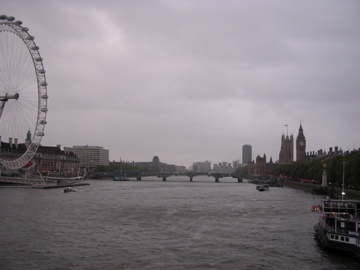
Well, that’s enough of my trip for now. I’m sure once I’m living there I’ll have more to say. I’ve included a few more pictures, one of me having high tea on Primrose Hill, one of the romantc, moody Thames, and a ‘political’ image taken at posh Sloane square…

Posted in London | 6 Comments

Brit Blog

…a great city is a kind of labyrinth within which at every moment of the day the most hidden wishes of every human being are performed by people who devote their whole existences to doing this and nothing else. Along a road there walks a man with a desire repressed in his heart. But a few doors away there are people utterly devoted to accomplishing nothing but this desire…
When I discovered this, I was almost tempted to think that I had stripped bare my deepest wishes and found that others shared them and that even if this were a kind of hell, perhaps it was my destiny.

-Stephen Spender, World Within World

More on my London travels soon…..

Posted in London | 4 Comments

Things That Give Me Hideously Vivid Nightmares, Chapter One

Posted in Uncategorized | 5 Comments

On Wretchedness

An interesting, disturbing dialogue has commenced amongst several of my thoughtful blogger friends, Odious, Jack, and Kate, on the subject of, well, wretchedness: Why and when one is most susceptible to it (or, blessedly, not), how one attempts to keep it at bay, and the compellingly asserted possibility that it is an unnecessary pain born and sustained only by a lack of faith in the overarching divine goodness available to us if only we should believe it’s there and actually meant for us. I recognize my own experience in Odious’s self-doubt, apathy, feelings of guilt over being apathetic, even in his attempts to blur out with over-stimulation and constant fidgeting that ugly self-realization perpetually lurking in his periphery.

This…. longing for goodness is so striking that I worry a great deal about my lack of it. I do what is right grudgingly at best and with a feeling that everyone had better appreciate the sacrifice I’m making in trying to be a good person, rather than chasing joyfully after goodness without a thought of anything else. I am not attracted to the Good; or if I am, I keep it hidden, to disguise my failure to be good as successful apathy. This self-deception is too often triumphant. It is, of course, pride that keeps me from confessing my desire, and I’ve so suppressed it that I feel it only sporadically anymore. It takes quite a shove to make me realize how much I would like to be good.
I don’t know about anyone else, but Pascal’s “distraction from wretchedness” becomes more and more my motivation. I find myself singing, not because I like the song, but because old iniquities are coming to mind and I don’t want to remember them. I read while I watch movies, because with only one distraction I might notice my fallen state, and the knowledge of how low I am is intolerable.

However, Jack’s position, that truly believing in the benevolence and even love of God cultivates a happiness magnificent enough to dwarf the insecurities, worries, and, yes, wretchedness, that come from a blinkered preoccupation with the secular, seems not just a mollifying sentiment but a wise and practical tenet to live by.

If we really believed, I mean really, experientially believed that we were personally loved by the Being Who created the universe, would we really be bothered if someone disagreed with us, belittled us, or really, harmed us in any way? Would it matter? The insecurity that compels us to lash out in despair would finally be resolved. Why would we need earthly validation if we knew that our real selves — not the narrow mean selves we’re forced into being — were forever irrevocably loved.

Indeed, I suspect that if I ever prove capable of taking Jack’s invocations to heart successfully, I will look back on my hours (months? Years? Decades?) of anxiety and dissatisfaction as needless capitulation to pointless doubt, hours spent in godlessness, while God was right there had I just been wise and courageous enough to believe. But it is hard to believe.

Not “in God”— Since the first time it was mentioned to me in a ghetto Baptist school when I was five, it has never been difficult for me to believe in the existence of a God; this probably indicates more my sloppy and unscientific nature rather than any effortless inclination to religiosity. No, it’s hard to believe that the belief in God’s love is enough to assuage the sting of even the pettiest insult, let alone the devastation of real human tragedy. I’m not assuming Ivan Karamazov’s stand of, “how can we believe in a God who allows babies to be murdered?”—he made his point very convincingly and even so was soundly mo’ded by the gentle and persistent devotion of Alexei. I can accept that God allows suffering and I wouldn’t assert something so myopic as that this proves His lack of benevolence or even His absence altogether—but I can’t help but draw the line at His love for each of us being a palliative or encouraging conviction.
For something to offer encouragement or alleviation from wretchedness, one has to believe that that thing promises real respite from the things that make one wretched. But we know that whether God loves us or not, we are stuck until we die in a world which promises a near-constant barrage of insults, failures, grievances, tragedies, disappointments, iniquities, deaths, humiliations, resentments, sorrows, loss, and wretchedness. We cannot point to anyone whom, perhaps, God loved more and thus made to suffer less, nor anyone whom God definitely loved less and so who conversely suffered more. No, God loves us all equally, and yet suffering is doled out at best, randomly; at worst, with the totality of a carpet bombing. Knowing that God’s love has no effect on the events, good and bad, that befall us in our lives, and that neither does it gravitate in greater quantity to those who work harder to be worthy of it (i.e. those who make a more concerted effort not to be assholes), how can the knowledge that He loves each of us provide real solace?

Reduced to bluntness, my point is, “God loves me. …And?”

God loves me and he loved Genghis Khan, and Ann Frank and Stalin, and the Grand Inquisitor and Dostoevsky and the slaughtered babies and their mothers and Milosevic and my dead father. This may be true, and I believe it is true. But how on earth can I glean comfort from it?

Posted in my neuroses, my pseudo-religiosity | 14 Comments

My Rejected Article

So some of you know that I’m writing for a trendy New York glossy these days (well, if it were more popular, it would be “trendy;” at this stage it’s merely aspiring to trendiness). They have commissioned several articles from me (well, if I were getting paid it would be “commission;” at this stage it’s merely orders I obey), one of which was this one I’ve posted. My managing editor asked me to write a treatise on the ugliness and outdatedness of shoulder pads for the March issue (yes, it’s a political science review). So I did, and for reasons not revealed to me, my article did not make the cut. This didn’t hurt my feelings too badly, as so far I’ve been rejected thrice by the New Yorker and roundly ignored by the Times, and with such giants on my resume of failure I’ve come to excuse the rejections of humbler enterprises as “slavery to fashion.” But you can read it for free. Bon Appetit!

Once in a while when I was in college my friend Araminta and I needed to assuage our blues with a trip off-campus. Rarely did this involve much planning ahead or even a token glance in the mirror before we got into her long-suffering Volvo and drove to Denny’s. In fact, we usually just set out in whatever sorry rags we had been studying in; sometimes sweats, sometimes PJ’s, sometimes whatever faded t-shirt and long john’s we had worn to class every day that week. While neither of us was a vision of glamour on these occasions, I noticed that she had a distinct advantage which saved her from utter frumpiness. For a moment I considered that it might be the two cup sizes she had on me, but then it occurred to me that the world is over-run with giant-busted women, and very few of them have that “je ne sais quoi” elegance that Araminta had in her bedraggled paisley jammies. What was it?

I realized then that it was her mannishly square shoulders which made even her most casual and untailored garments seem chic and complete. Such shoulders, in their broadness, accentuated the smallness of the waist, provided a frame for the bust, and minimized the width of the hips (a woman built like this rarely has to worry whether her “butt looks big”—what could possibly look big next to those shoulders?). Surprisingly, this broadness across the back that I described as “mannish” emphasized the femininity of her figure, and she didn’t have to do any “dressing up” to look, well, dressed up.
This realization made me wonder why I seem to be the only woman who mourns the loss of the shoulder pad in womens’ fashion today. Why would women have ever given up something so flattering and, forgive what I’m about to say, aesthetically empowering?

I should explain. The shoulder pad entered womens’ fashion in the 1940’s as a variation on the soldier’s uniform. The country was largely supportive of the war effort and naturally, fashion reflected this. It also helped that Adrian dressed his muse, the popular film star Joan Crawford, in suits with padded shoulders, and also that rations on various fabrics restricted designers from indulging in the usual flourishes to add excitement to their designs: full skirts, puffy sleeves, etc. They suddenly had to be very economical in their creations, and the sleek, sparse suit padded and squared off at the shoulders proved an appropriate, and elegant, solution. Women’s social role shifted as well; she entered the workplace, taking over many of the jobs usually occupied by men who were now abroad, and the authoritative look afforded her by this simple adjustment to the cut of her clothes fit her new image perfectly. She didn’t look like a man, but she did look powerful, in a way only men had previously been able to appear.

Then the war ended, and with it not only the rations on fabric, but the need for women in the workforce; in fact, a massive campaign was launched to drag women back into the home to free up those jobs for the returning G.I.’s. After enjoying a taste of a fairly independent life outside the home, women were now maneuvered back into their formerly sequestered lives (a problematic trend astutely, famously, documented by Betty Freidan in The Feminine Mystique). Not surprisingly, fashion took full advantage of the lift on rations and came out with skirts embellished with extra yards of fabric. Fashion also relaxed its wartime strategy of militarizing the female image. The ‘soldier’ look was yesterday and the new look was far softer and less structured, except in the infamously pointed brassieres popular in the fifties. This look was somehow, in the never-humble opinion of this amateur social scientist,…so obedient. Poodle skirts, skinny-heeled slingbacks, and good girl peter pan collars: the only body parts to enjoy special emphasis were the good ol’ mammaries (just in time for the baby boom! Co-inky-dink?). The shoulders, which in the forties had been enhanced to the effect of suggesting strength, professionalism, and an authority at least superficially on par with that of the male, were now allowed their natural weak slope, their former emphasis now dropped several inches south.

Jump ahead to the 1980’s: women once again storm the workforce, not due to any national crisis, but simply because it is the next step in the progression towards equality with men, initiated by the women’s lib movement. As newcomers to the corporate world, women do what they can to fit in, the pervasive mentality being that women have to prove they belong in this traditionally masculine domain. Women’s office clothes now mimic the man’s suit: though the bottom half is a skirt with pumps (because we couldn’t go so far as to let women actually be comfortable in slacks and flat shoes and even, god forbid, unshaved legs) the top half is a smart blazer with, again, shoulder pads. These shoulder pads, however, are an exaggerated version of those of WWII. The new shoulder pad doesn’t merely level and extend the shoulder a centimeter or two; it often takes the shape of a curve, which creates small humps at either shoulder, achieving that “linebacker” look bemoaned by reactionaries to the trend,–or it extends so far out that the wearer has to turn sideways to enter doorways. Perhaps this is a manifestation of “80’s excess,” or perhaps designers just don’t want to be caught repeating a trend that had been made popular by someone else four decades previous, so they revamp it in this mutant state. In any case, the look lasts for about as long as it seems necessary for women to masculinize their image, which is not much longer than the first decade of their corporate life.

Since then, women have felt more at home in the business world and thus entitled to dress as women rather than as masculinized females. The shoulder pad has been shrugged off. Will it come back? Most likely if it does, it will be for purely aesthetic reasons, as there are so many fewer arenas left in which appearing manlier could benefit a woman; she has her own identity now, and that identity has been, at least in theory, validated by her society. The author, if you haven’t guessed already, mourns the shoulder pad’s absence in popular fashion, also for purely aesthetic reasons, but does not foresee its return any time soon. Why? There are two reasons for her pessimism. One of them is that fashion has basically fallen off the deep end in its escalating pursuit of skankiness. The questions now seem to be, “how much of my pubic hair do I need to wax off in order to wear these extra-low-rider jeans?” and, “does the bra strap peeking out of my tank top match the thong peeking out of my pants?” In other words, the whole ideology behind today’s fashion appears to be “how to be sexy (in that “Sexiness for Boneheads” way taught by MTV)” rather than “how to look good.” Coco Chanel once said that the proper goal for a woman when she dresses herself should not be to look rich, but to look elegant. There is a sorry lack of such subtlety in today’s trends. Sexiness is defined by what seems like a checklist of the obvious. Tits showing? Check. Ass showing? Check. Gams showing? Double check. Midriff exposed? Check. The sexiness of a woman in a tailored and, yes, padded, dress or blazer (think Lauren Bacall in To Have and To Have Not, think Kate Hepburn in Philadelphia Story, think Evita) is too complicated to make the cut in today’s world where Paris Hilton is an style icon and rap-video hootchies herald the newest accessories your fourteen-year old will be begging you to buy her. A padded garment emphasizes a body part that is not distinctly sexual, and thus has very little hope of gaining popularity until a massive shift takes place in the collective psychology of our society.

The other reason I don’t think the shoulder pad will come back any time soon is because women simply don’t know what looks good on them. So many of us don’t realize that it is preferable to look like a linebacker than like an overgrown cheerleader. If women knew what looked good on them, these fashions would have died far sooner:
1) Jeans with large areas, usually thighs and/or buttocks, bleached out (“Do these make my ass look fat?” You bet.).
2) Shoes designed to suggest the head of a duck-billed platypus: the turned-up toe and the heel extended behind the ankle make one’s foot look two sizes larger. No good!
3) Baby-T’s: even if you do have washboard abs, is it really appropriate to have your stomache showing oustide of the gym or a beach on St. Bart’s? And for the rest of us, why abuse your pooch by making it bulge over the top of your jeans? Not attractive!
4) Pink eyeshadow: Why buy over-priced eye cream if you’re then going to wear makeup that makes you look like you’ve been crying and that’s why your eyes are puffy (and yes, pink eyeshadow makes your eyes look puffy!).
5) The Jennifer Aniston ‘do: Sorry ladies, those two years back in the ‘90’s when you all were whipping your stylists into a frenzy over that ill-begotten coiffure? Bad idea! It made your head look big, it hid your face, and it emphasized the lines on your neck (and you who had such lines were too old to be imitating 20-something sitcom stars. For shame!).
6) The ruffled mini: and sorry, Paris, the only woman with the legs for this skirt is my three-year-old niece. Give it back!
7) I already mentioned this but it bears reinforcement: Consider this, ladies, would Jackie Kennedy have worn an exposed thong?

These are just a few of the objectionable trends of recent years. Perhaps I should start a “Top 100” list.

Posted in Publishing rants | 1 Comment