Fire up your iPads…

because my books are available in e-book form now. 🙂

http://www.blurb.com/user/store/larcher

Posted in Uncategorized | Leave a comment

Have you seen “Savage in Limbo” yet?

Posted in EVENTS, San Francisco, theatre | Tagged , , , | Leave a comment

David Linger’s “Narratives in Porcelain at Meridian Gallery, SF Examiner


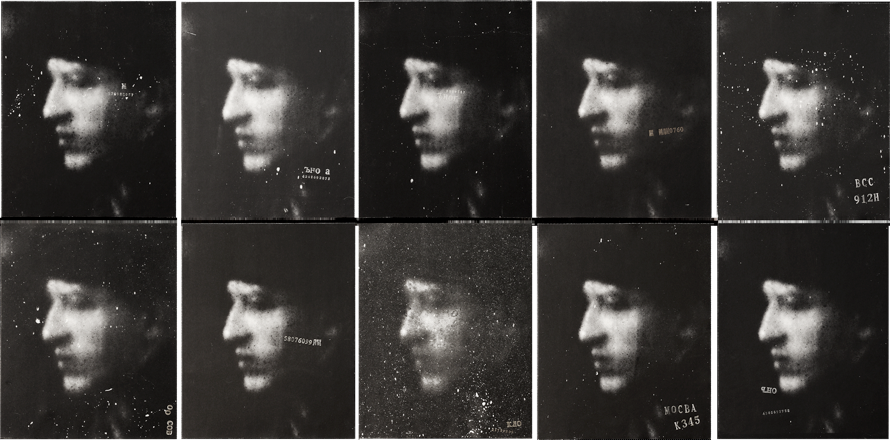
On the one hand, works in David Linger’s “Narratives in Porcelain” on view at Meridian Gallery evoke a vision of Russia that is straight David Lean — all bare birch trees, troikas, fur hats and snow-swept promenades.The fuzzy black-and-white underglaze prints on translucent porcelain, made from photographs Linger took on a trip to Moscow in 1969, depict the romantic, melancholic vision of the Slavic world embraced in poetry, song and historically whitewashed cinema.On the other hand, Linger manipulates the images, repeating them in varying degrees of sharpness, homing in on an unsuspecting face, stamping the images with Cyrillic letters like in some bureaucratic code (but which is in fact gibberish). (Read more at the San Francisco Examiner:  http://www.sfexaminer.com/entertainment/2011/11/linger-s-romantic-images-have-sinister-undertones#ixzz1cxDRqf00)

Posted in photography, REVIEWS, San Francisco | Tagged , , , , , | Leave a comment

I had problems with Asian Art Museum’s (and V&A’s) Maharaja show, SF Weekly

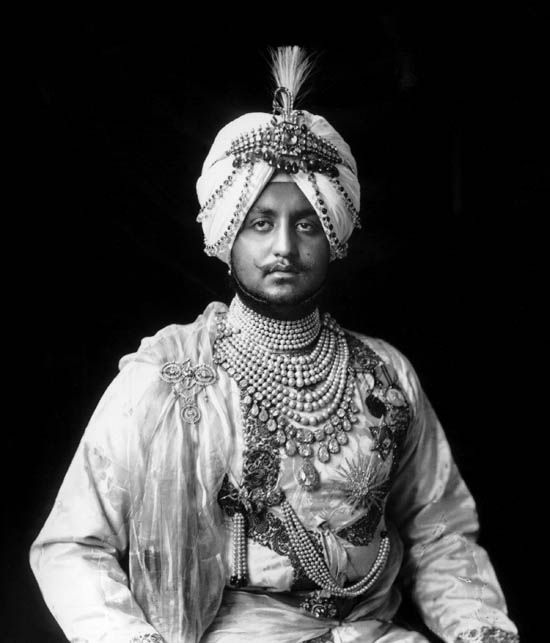
Seriously. Get over yourself. Bhupinder Sinh of Patiala, 1911

Any exhibition on the wealth of a nation’s royal class is an exhibition of the inflated amour-propre of men with money and armies at their beck. Well-fed bluebloods wrap themselves in theater curtains, pile on the baubles, and commission royal portraits for which they assume expressions of such preposterous self-importance as to nullify any trace of human dignity. It’s a recurring expression, too; you see it in the portraits of Henry VIII, the Florentine dukes of the Renaissance, and Rigaud’s portraits of the Sun King. Add to the club the princes on display in the Victoria and Albert’s import to the Asian Art Museum, Maharaja: The Splendor of India’s Royal Courts.

It’s not that there aren’t objects of great beauty or fascination in the Maharaja exhibit, and it’s not that you won’t learn anything if you’re in the market for a (superficial) lesson in Indian history. But troubling is that this display of ostentation is treated without a hint of irony. Maharajas (from “mahant rajan,” or “great king” in Sanskrit) are discussed in noncommittal terms of their duties as rulers — your usual, “protect, serve and patronize the arts” — no talk of how they did that.

When considering an exhibition of 300 years of conspicuous consumption on a scale to make Russian gas oligarchs blush, the questions that come to mind are, “Where did all that money come from? What tactics did he use to levy taxes? How did he keep from getting his throat sliced open? Who made these jewels, and what were the conditions in the mines? What was the punishment for speaking out against the maharaja?” Basically, “At what cost, this extravagance?” Nothing.

Some of the paintings depict a king atop a magnificently jeweled elephant (the ceremonial elephants are draped with what is called a jhool), and his subjects, in what is described as Darshan, the “dynamic exchange of seeing and being seen by a superior being.” In the magnificence of their humility, the kings borrowed this notion from a Hindu one that says a deity, in revealing himself, bestows grace upon his followers, who in turn are made receptive to this grace by seeing him.

Darshan is discussed and presented as if there is no  possibility that the modern democratic mind can reel at such ridiculousness. Whatever a demigod is, it is not a simple or indisputable concept. (continue reading)

Posted in painting, REVIEWS, San Francisco | Tagged , , , , , , , , | 1 Comment

Lines Ballet’s Resin Review, HuffPost

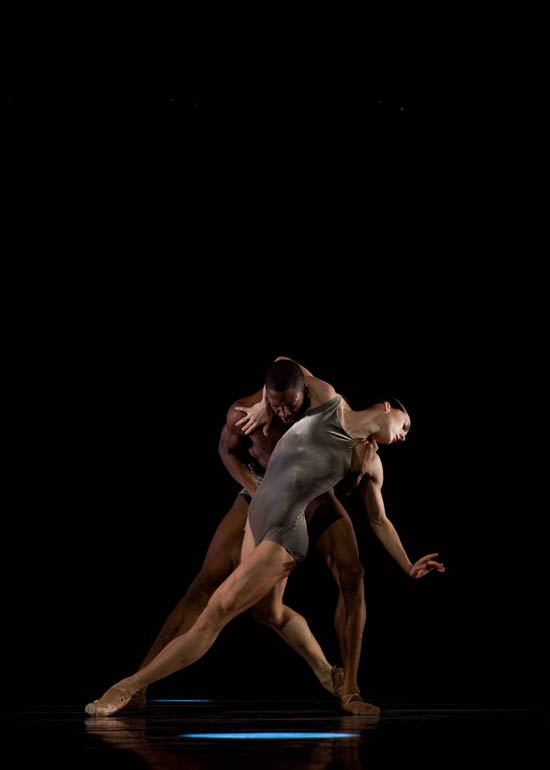
Resin, the showcase of Lines Ballet’s fall season, exemplifies what makes the company a treasure for San Francisco and the world of dance. Set to the music of the Sephardic tradition (songs of the Jewish diaspora into Yemen, Spain, Morocco, and Turkey), Resin makes one wonder why more choreographers have not used this music; its complex syncopations meet their match in the sharp rigorous movements of the ballet-trained body, its sinuous vocalwork, in spines made lithe through years of port de bras. (continue reading)

Posted in ART, ballet, dance, REVIEWS, San Francisco | Tagged , , | Leave a comment

Lines Ballet preview, SF Weekly

The Alonzo King Lines Ballet is a true San Francisco institution, not only because it has been around for nearly 30 years, but because it embodies the diversity of San Francisco in almost every aspect of its existence. Not too long after San Francisco Ballet’s Evelyn Cisneros, a Mexican woman, was still having to powder her skin white, Lines was proudly racially diverse. The music King choreographs to ranges from classical European to traditional Moroccan and Central African and more. His choreographic style combines classical ballet’s discipline and grace, as well as the primacy of the beautiful line (fittingly, considering the name) with flashes of athleticism and the wider gestural vocabulary of modern. (continue reading)

Posted in ART, ballet, dance, San Francisco | Tagged , , , , | 8 Comments

Elin Høyland’s “Brothers” at Rayko, for the Huffington Post

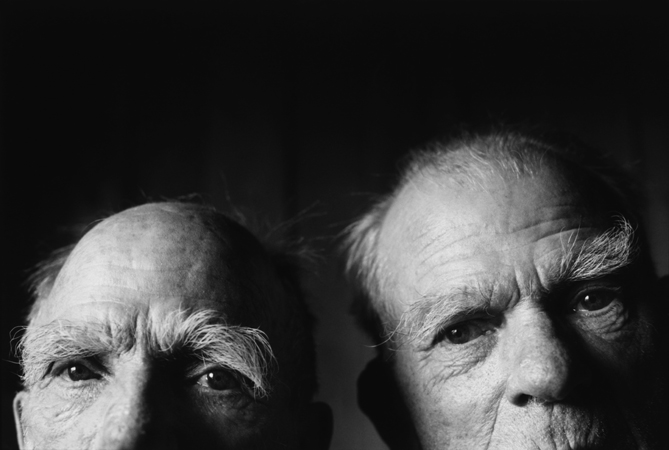
It is tempting to regard a life that takes place “off the grid” of modern culture — sans TV, sans cellphone, sans facebook, sans travel — with pity, as if the person living this way was “left behind” or just doesn’t know what he’s missing. The temptation to belittle this choice — especially when it is a choice and not simply the result of poverty and isolation — is rooted in the suspicion that the trappings of modernity have provided at best illusory improvements on our simpler past. The nagging feeling that what we have lost of the old analog way of life might be of equal or even greater value than what we have gained in our progress towards an evermore technologically complex, global society, never manifests so acutely as when we are presented with people who have “opted out” of the whole business. (continue reading)

Posted in ART, photography, REVIEWS, San Francisco | Tagged , , , , | Leave a comment

I visited Paul Madonna’s home and studio, SF Weekly

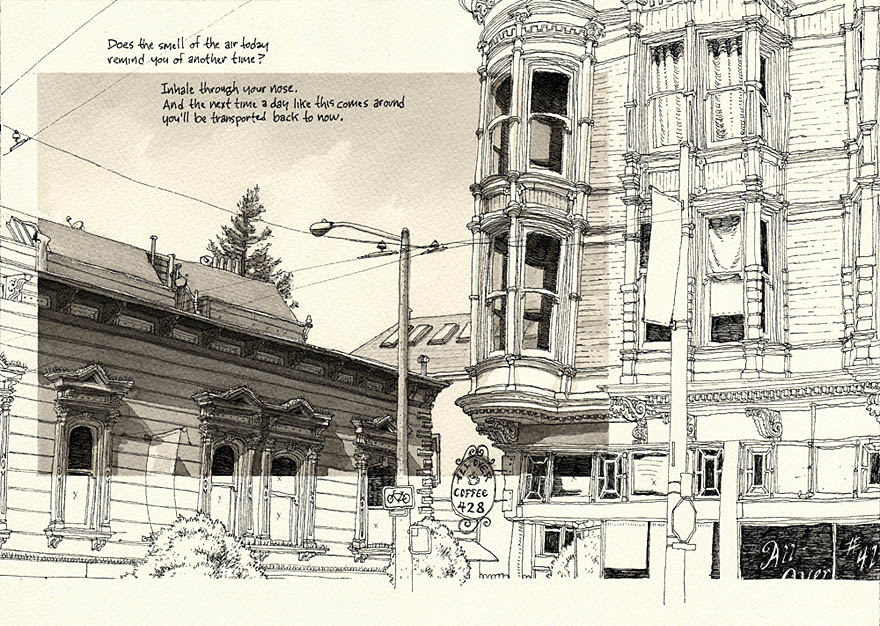
One doesn’t expect to visit an artist’s studio and be afflicted with apartment lust (unless one got to visit Monet at Giverny or Damien Hirst’s suite at Claridge’s). But Paul Madonna, we learned thanks to SF Open Studios, lives and works in a beautiful Victorian in the Mission with high ceilings and curved walls. It seems perfect that Madonna lives in a quintessential San Francisco flat, considering he is the artist and writer whose ink drawings of the city’s famous and obscure corners are serialized in the Chronicle’s All Over Coffee, a City Lights-published book of the same name, and a new book titled Everything Is Its Own Reward. Although his work includes drawings of other cities — he even showed us a stack of sketchbooks of his travels through Asia awaiting development — most of the work showcased in the two books and the serial depicts this city. (continue reading)

Posted in damn good, EVENTS, San Francisco | Tagged , , , , , , | Leave a comment

Wrestling, marinara, and buzzy things: the Indie Erotic Film Fest at the Castro

I wrote this for SF Weekly but they were unable to use it.

The health hazards of corsets are well-known: they crush your liver, squeeze your lungs, and sometimes, even break your ribs. They force you to take quick, shallow breaths, which leave you dizzy and often, unable to think clearly. Depending on the era, the corset constrained either the waist alone, or the waist all the way past the hips, and it’s no wonder that women were long considered incapable of rigorous physical or mental activity: their everyday dress literally crippled them. If you can’t breathe freely, you can’t function. Ask your yoga teacher.

The corset was the physical symbol of centuries of oppression, and  women had to dispense with it as an early, necessary step towards liberation. So it’s strange that the erotic, which distinguishes itself from the pornographic by associating itself with the mental, rather than purely instinctual, element of sex, has adopted the corset as its uniform. Erotica touts itself as the classier, gender-and body-positive, culturally-minded and generally more holistic alternative to its plasticized commercial cousin. Erotica is Schiele and Beardsley and AnaĂŻs Nin; porn is Larry Flynt and Hugh Hefner and German shise films. Erotica is natural breasts and unmown pubes and liberal arts degrees; porn is razor burn and bleached assholes and abandoned GEDs. You can watch as much “porn” as you want on the internet, risking infecting your computer with as many viruses as the cast of Bareback Mountain, and you probably want to do so alone, with the volume turned low, then clear your laptop’s search history, and wonder guiltily over the lives and probable addictions of the dead-eyed waifs pantomiming the throes of love for your arousal. But to enjoy “erotic” films, you don your glad rags, bring a date to the grandiose Castro Theater, charge the tickets to your credit card without a second thought, chat with the well-heeled actors at the pre-party, and tell your mother you’re going to blog all about it. Many find some degree of bondage or oppression a turn-on, but isn’t it nevertheless a contradiction that corsetry and body modification are as popular as they are amongst the sensitive and progressive proponents of erotica as opposed to porn, which people more readily associate with exploitation and harm to women?  I doubt plexiglass heels and buttfloss have done nearly as much damage to womankind as the whaleboned torso-cages of our past.
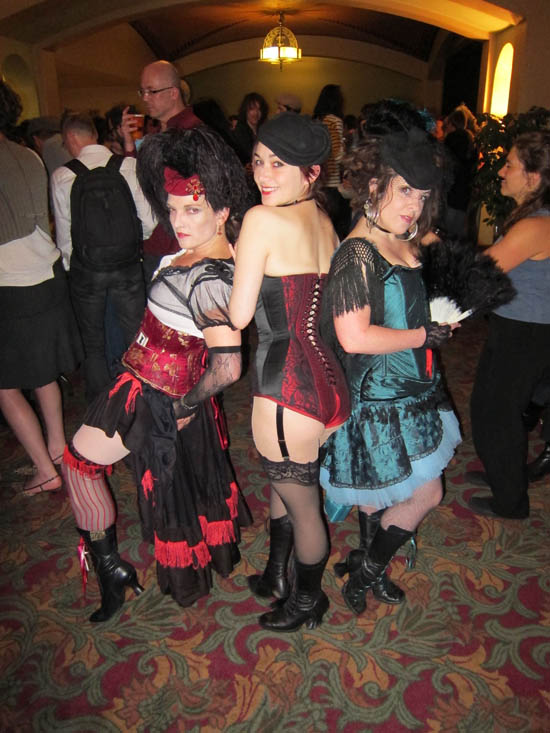
These women don’t look particularly oppressed.

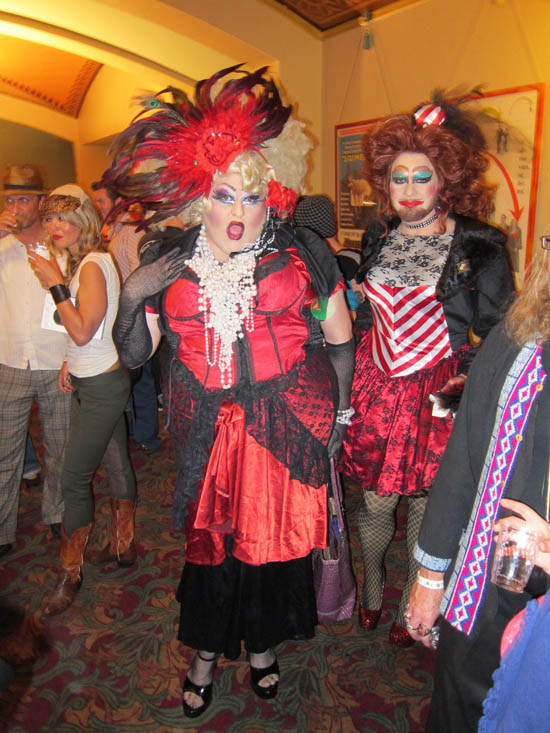
In any case, Hayes Valley’s Dark Garden dressed the staff of the opening night gala of the Indie Erotic Film Festival at the Castro, which included (producer) Good Vibrations’ employees, sexologist Dr. Carol Queen, drag queens Peaches Christ, Hugz Bunny, and Lady Bear, who provided catty and occasionally witty commentary on the short films presented. They looked fantastic, and we did not hear a single rib crack.

The pre-party included copious and stiff (what??) drinks, piles of brushchetta and garlic cheese bread with small tubs of marinara one hoped to god no one had double-dipped in, and   activities like a spin-the-wheel game with prizes such as DVDs, condoms, and devices requiring batteries and lacking phthalates. I won a film about “MILF”s and a dolphin-shaped buzzy thing with straps. I wouldn’t know what to do with those so on my way home I dropped them in a deposit box for a charity benefiting starving orphans with harelips.

What a great hat!

This lady won something that attaches to your finger and vibrates. I assume it’s for some sort of massage practice; in fact, I’ll bet that’s what people mean when they go on about rolfing.

The film festival was also a contest, decided by the dubious judgment of a crowd that bellowed most loudly at the film it thought most accomplished. This year that prize went to  a Mexican film called “La Putiza.” “La Putiza” follows the young Lucha Libre wrestler, Diamante, who looks like Jean Paul Belmondo and is easily distracted by fantasies of his wrestling opponents doing gayer things to him than Lucha Libre wrestling. He somehow ends up in this hero quest, bidden by “The Master” to overcome a myriad (or maybe around three) obstacles such as “The Penetrator” and a voracious man-orgy in order to prevail and assume the ancient sacred title of “Aztec Dick.” By “overcoming,” The Master specified that he meant “not coming,” which at first seemed a bit too easy a task for any man over the age of fifteen, but considering the Vegas Bellagio display spouting off around him in the man-orgy, perhaps Diamante’s struggle to contain himself deserved benefit of the doubt.

The thing is, it seemed like the main reason for the huge amount of enthusiasm for this movie was the fact that it had so many penii in it, and this audience at the Castro that night comprised many, many fans of the penis. There were a few clever elements, such as the animated comic-book effects (“Wham! kerpow!“), but generally it was written and acted like a pornographic version of a Spanish soap opera. This was a big improvement on your average porn film (and Spanish soap opera), but this was not a festival for “porn,” but for “erotica” and we generally expect more from erotica. There were other films with (sadly, fewer dicks) much better acting, such as “Tooth and Nail,” which depicted a young woman isolated in an empty, generic room, battling some nameless but potent psychological or mnemonic dread. Others were LOL-level funny, like Tales of Mere Existence, which described the author/director’s magnificently awkward history with women and the hilarious and depressingly accurate “What Would Penis Do?” explanation of men’s habit of “thinking with their dicks” and how it ruins everything but can’t be helped. This was animated in simple, to-the-point marker drawings that “drew” themselves into every scene with impeccable comic timing to accompany author Levni Yilmaz’s deadpan narration. As a comic achievement, even as a piece of writing and graphic art, this film towered over the others, but perhaps people were reluctant to give first prize in an erotic film festival to a film with a general look like this:
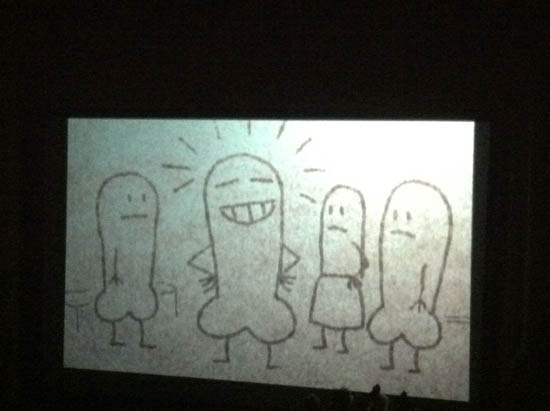
not erotic enough?

Another film, “Salam and Love,” appeared at first to be your standard ’80’s music video of lesbians petting in a cave surrounded by Pier 1 Imports’ entire stock of votive candles. In unusual pudeur for a French film this showed nothing beyond petting, but when the women finished their softcore fumbling and dressed, one of them assumed full-body burqa, and the other, a US Army uniform. Showing the night of DADT’s repeal, this film drew cheers. While the quality of the films varied, and the audience’s taste and my own diverged somewhat: the  submission I found really disgusting was “Burger Time,” in which a perfectly good hamburger is destroyed when a transvestite attacks a young woman while she eats her takeout and smears the burger in question all over his victim’s face, stuffs great soggy chunks of it into her mouth, and utters the unforgettable line, “It’s burger time, bitch!”

Posted in REVIEWS, San Francisco | Tagged , , , , , , | Leave a comment

“Illusions of Grandeur” at 111 Minna Gallery, Art Practical

Illusions of Grandeur, at 111 Minna Gallery, showcased the abstract and Surrealist-inspired work of two local painters, NoMe Edonna and Lee Harvey Roswell. Both self-taught, each artist possesses an eye for composition and favors bold colors, as exhibited by the great visual impact of the works on display. Their paintings are also provocative on an intellectual level, employing more familiar and obscure symbolism, inventive and perplexing juxtapositions of elements, and a darkly humorous tone that contrasts with the often-grim themes they explore. (continue reading)

Posted in ART, painting, REVIEWS, San Francisco | Tagged , , , | Leave a comment