The Cries of San Francisco in SF Weekly

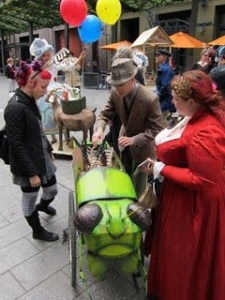
You don’t have to pick a special day on Market Street to be yelled at by strangers. And it’s not that unusual to encounter those in odd outfits trying to sell you objects and services of ostentatious uselessness. But Saturday, the “Cries of San Francisco,” put on by Southern Exposure, offered a witty and sometimes touching variant on an old theme based on The Cries of London, Francis Wheatley’s seminal 18th-century oil paintings depicting London’s street sellers.


Posted in ART, publishing, REVIEWS, San Francisco | Tagged , , | Leave a comment

My review of Doug Rickard’s "A New American Picture" in the San Francisco Examiner

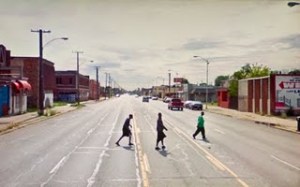
Roofs face the elements without shingles and collapsing, store fronts stand shuttered and windows boarded over, and gingerbread crumbles off formerly elegant facades. In Doug Rickard’s “A New American Picture” on view at Stephen Wirtz Gallery, the sense of desertion pervading the images remains strangely untempered by the spotty presence of people. They amble past decrepit houses and drive on cracked, untended roads. It’s hard to imagine the buses they wait for will arrive. They seem more like trespassers on long-abandoned property than residents of Detroit, Memphis, Fresno and Houston.

Posted in ART, photography, REVIEWS, San Francisco | Tagged , , | Leave a comment

My write-up of "First Thursday" openings at 49 Geary in SF Weekly

Clusters of young Americans propped themselves up on Golgothan stilettos, clutching their plastic cups of white wine with one hand and texting virtuosically with the other. Some hood-ish-looking young men in ‘do-rags dragged their pants behind them from gallery to gallery. Many people had expensive-looking priapic-lensed cameras dangling from their necks.

Posted in ART, EVENTS, REVIEWS, San Francisco | Tagged , , | Leave a comment

My review of Richard Learoyd’s Presences at Fraenkel Gallery in Art Practical

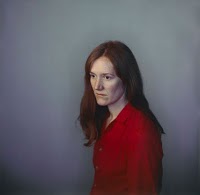
It’s hard not to feel like an overzealous dermatologist examining the subjects of Richard Learoyd’s exhibition at Fraenkel Gallery. His large-scale direct-positive images reveal a degree of epidermal detail one usually only gets to see while making out under an interrogation lamp. The shallow depth of field that marks Learoyd’s portraits and that shows imperfections with pitiless clarity—a rough patch here, an incipient pimple there, weirdly dilated pupils—somewhat mitigates the monumental quality lent them by the size of the images and the solid, sometimes brilliant hues he clothes his models in (when he clothes them).

Posted in ART, damn good, photography, REVIEWS, San Francisco | Tagged , , | Leave a comment

On Not Marrying

Marriage has always held a place in the image of myself that seems so far away, I almost believe I will have to be a completely different person by the time it happens, the way a child must imagine herself to be an unrecognizable person by adulthood – several feet taller, dressed in adult clothing, speaking in an adult voice, concerned with adult tasks. It’s easy to imagine yourself as an adult when adulthood is so far away from you that it renders considering who you currently are, in your mental construction of the imagined future self, a bit ridiculous. When I was little I thought I’d be like Phylicia Rashad when I grew up. Such deserts of time stretched between myself then and my adult self that more drastic personal revolutions than a mere change in skin color would have to take place to transform me from a child who played with her toes to the dignified woman who could instill awe into the hearts of her unruly family with a few sotto voce threats and a confusingly sexy stare-down.

But I’m now at an age when many of my friends are getting married, or have already gotten married and are now starting their own families, or are even divorcing. And yet I feel just as distant from the woman I imagine myself needing to become in order to be married as I did when I was a child. It has in fact become more difficult to imagine myself so, because, unlike the enormous changes to my person I could take for granted would happen between then and the imagined now, I have to accept that I actually am mostly as I will be for the rest of my life. For instance, my skin color won’t change, but then neither will my personality; I’ll probably never be the sort of career woman and mother who can subdue her family with a sexy stare-down and then be at work at 8 in the morning to start a day of subduing New York’s legal system while wearing pointy high-heeled shoes and power suits. I don’t mind this, but it’s something I know won’t happen. The person I am now is basically what I have to work with, and my imagined married self has to look, and act, something like I do now. But I couldn’t be married and act the way I do. I mean, I could, but I wouldn’t want to be married to someone who’d put up with that.

What man could prepare himself for the size and scope of my vanity? It is epic, it is legion; I am the Beowolf of self-regard. I’m not exactly ashamed of this, but neither do I want someone beholding its hugeness every day, straining his philosophical faculties to make sense of his own minuteness in comparison with it. It’s not like I could hide my mountain of beauty products somewhere in the bathroom where he wouldn’t notice it, or get crushed under it, or sucked into its gravitational pull. I can’t just leave my toothbrush and some baby shampoo and an unassuming white washcloth out and pretend that’s all it takes to achieve this fresh-faced fakery that is my look. It’s not that I’m profligate with my products either; I use everything up and then buy more. How can I explain that I really do need one cleanser in the morning and a different one at night, and an exfoliator twice a week and a mask and a peel and different moisturizers for day and night and parts of my face and times of the month and it all makes perfect sense to me, but yes I understand there’s not enough room on the shelf for all these bottles so please build some more shelves? It is almost impossible to convey what eyelash conditioner is without appearing ridiculous. And also, I know aging drag queens who own less makeup than I do.

And clothing—I have a walk-in closet. It is my bedroom. I also have an annex of bulging wardrobes challenging the floorboards of my apartment in the Bronx. I like vintage clothes, which went out of style before I was born and thus will never go out of style in my heart. Unless I gain weight and they no longer fit me, why would I get rid of them? Yet I shun jobs that have a dress code that doesn’t include Uggs and yoga pants. I once turned one down in London because it would have required me to teeter about in high heels on Harrod’s marble floors for 6 hours a day. Any job that starts before ten in the morning is a job that will never see me in mascara, and only occasionally with clean hair. So I can’t even promise a consistent payoff to the avalanche we would be living under till death by suffocation do us part. I don’t like imagining my future husband trying to look manly while being crowded out of his own house by a burgeoning forest of chiffon ruching, bias-cut crepe, and those fake pashminas with pictures of peacocks in metallic thread I love so much. He would try to talk sense to me, offer to drive me to the Goodwill drop-off locations, or even help me to start an ebay boutique. I would grow to resent him for refusing to acknowledge the value of a minidress I wore both to my senior prom and to opening night at the opera twelve years later, or the fact that yes, gorilla fur is un-p.c., but totally worth it and so much warmer than any of my other capes, or that these are not rags, these are my Bag of Sentimental Panties and no, they are none of your business.

And what about our domestic life? Obviously I am too much of a feminist to ever willingly take on the role of housewife (and my secret is that my feminism in this regard is buttressed by a generous helping of laziness and apathy that eliminates housework as a serious consideration for me anyway). But normal couples cook, or take turns cooking. I know people who enjoy it. They buy ingredients, and read recipes, and wait patiently for stuff to boil. They close their eyes and lyricize about the near-spiritual satisfaction they get from communing with the various twigs and animal parts and different-colored dust they flavor stuff with. Then they sit down, fully clothed, at a table, with mats and serving spoons, and eat in silence or while exchanging civilized anecdotes about their lives. I only want to eat if I can sit pantsless in front of the internet while I’m doing it. And I only cook for parties. Spending time in the kitchen is only worthwhile if at least two dozen people will adore me afterwards. Otherwise I can just pick the M&Ms out of a trailmix bag, sprinkle them over a cup of applesauce and be done with it. I only use my stove to store my wicker basket collection and for my weekly death-by-garlic pasta binge, during which I prepare enough food to feed Haiti, and eat it all myself. I’m not sure I’d ever want a man to know these habits of mine, let alone be legally bound to share in them with me. And after ten or twenty years of letting him cook for me, I might start to suspect I’m taking advantage of him, and feel guilty about it.

As I get older, I wonder about how much of my life depends upon privacy, how much of my daily routine I would suppress if there were someone watching me. Do I want someone to witness me choosing to watch LOLCAT videos rather than read a Great Book, or even a good book, or even a full HuffPo article, before bed? Do I want to inflict my apocalyptic hormonal mood swings on an innocent man, or worse, stifle them for his sake and just guess at when the ulcer’s going to hit? Do I want someone possibly taking a dim view of my frequent daydreaming and then telling me to put some pants on and go get a job at Starbuck’s or Home Depot or wherever? I suppose that’s the fear, isn’t it, that the proclivities of mine I secretly suspect aren’t entirely benign but that I usually assume will appear charming to most other people, will be seen and comprehended in their unsimple totality by someone who would get to be as much of an expert on me as a husband would. And if he’s a man he would then encourage me, maybe even try to help me change, put his hands on my shoulders and turn me to face reality, which I always hate doing and which is why I generally can’t ass myself to do it on my own. And then I’d have to admit that I clung to a basically childish version of myself for longer than was seemly, and that instead of dragging myself up out of it, I needed a man to compel me to. God, I hate him already.

Posted in my neuroses | 13 Comments

Word.

A friend turned me on to The Believer magazine, which is now my bus and train reading. In the February issue, there’s a fascinating series of essays by transgender author T Cooper on different aspects of his transformation from female to male: unsent letters he wrote to his parents explaining his decision, personality changes he has gone through since his transformation, elements of womanhood that one would think he’d understand considering his past but doesn’t. But one essay, on the subject of his frustration at the “slip-ups” people still make regarding his gender such as accidentally referring to him as a “she,” suggests his frustration at not having his identity acknowledged and respected has surpassed his empathy for human error. It’s ironically the one closed-minded part of an otherwise illuminating, and entertaining, treatise.

Cooper argues,

“…say you have a good friend you’ve known for years. You used to go out to bars with this guy, snort drugs, hook up with strippers, and then wake up and do it all over again. If this guy is now 5 years sober and happily married with 2.5 perfect children, you probably wouldn’t call him up every day and ask him to score some coke and go whoring with you…It’s not the world he lives in, even if you still think or still wish he did. Maybe it never was to him, it never quite fit, and he had to go through all that to get to the happy rainbow place he is today.

Or, say you always played basketball with a buddy; that’s all you did together…But then your buddy is in a gruesome Staten Island Ferry accident, leaving him paralyzed from the waist down, exiled permanently to a wheelchair. Would you forevermore go up to him, see him sitting there, and then be like, ‘Yo, you wanna go down to the corner and play some pickup? Oops! I didn’t mean to say that! Sorry, it’s just so hard to get used to!’

No, it’s fucking not…..it makes me feel like shit when people refer to me as she. It doesn’t matter if it’s with the best of intentions, or whether it’s obvious to those in earshot that I’m male, and nothing’s technically been lost, that there’s clearly been a mistake. Or even if they are talking about the past.’

(quoting his wife) ’How would I feel if I were called sir while I was out on a date, wearing a dress and heels and cherry lipstick? How abnegating it would be to have the world decide, no matter how many signals you give, that you are something you are not.’

Of course, his frustration is understandable, and so is his pain. But I’m not sure his impatience with people who slip-up, and his dismissal of them as somehow lazy or dismissive themselves, is fair. It got me thinking about how I “group” people in my mind, what the most basic thing about them I remember and associate with them is. What are the characteristics that, no matter how the signals they deliberately send change over time, identify them to me?

This analogy might not immediately be apparent, but the essay reminded me of the way I think of words: how I group them, how I remember them, how they affect me. Sometimes when I’m trying and failing to remember a word that is “on the tip of my tongue,” the closest attributes of the word itself that I can remember might be the number of syllables, or the rhythm of it, or perhaps whether it was Germanic, Latin or Greek in origin. If I remember speaking it aloud to myself, randomly throwing in a few rough breathing marks for fun and imitating a recording I once listened to of The Iliad recited in a dialect believed to be similar to Old Ionic, I know the word was Greek. If I recall intentionally mispronouncing it in an Italian accent, I’ll know it is from Latin. If it sounds sexy or romantic, I’ll know it’s Frenchified Latin. If it’s phlegmy and uncouth, it must be German.

But more palpable than my memories of the attributes of the word itself, are my memories of how I felt when I first encountered the word. I can remember whether I was happy or sad, in love, depressed, feeling accomplished and smug, or put-upon and useless. I can remember if I was eating at the moment, and if so, whether it was sweet or savory, and how I felt as I was eating, if I was just grazing or eating until I was full, or ate too much and felt sick. Or maybe I was just having a coffee and felt the acid tenderize my stomach as I first read or heard that word.

That’s another thing I can remember even if I can’t remember the word itself: I know if I heard the word on TV or read it in a book. If it was from the television I can remember whether it was on a news or commentary show or in a movie or serial. If it was news and commentary, I can remember if I agreed with the person who used the word, and if it was a serial, whether I had a crush on the character who used it. If it was in a book, I can remember if it was fiction or non-fiction, and if fiction, which voice spoke the word aloud in my mind’s ear: if the narrator was female, regardless of the cultural origin of the book, it was my own, as I pride myself on being good with dialects. If male, the voice belonged to Jeremy Irons, naturally. If it was non-fiction I can remember whether it was British or American, or a translation. I can remember if I learned the word in conversation, and whether that conversation was in America or Europe, and if in America, on what coast, and if on the west coast, whether it was with a friend from high school, the theatre, or the opera, and if in New York, at Saks or some other job, over drinks or lunch or shouted at a noisy party. I can remember my status relative to the person who used the word, if it was a boss or a teacher, or a colleague, or a nuisance—did I feel intimidated, worried, delighted, or annoyed when I heard this word? Do I associate the word with satisfaction (words I learn while happy) or frustration (words I learn while trying to distract myself from unhappiness)? I can remember that, if not the word.

The clues are ghosts, and ghosts of ghosts, not of the thing itself, but of who I was at the moment of reception. It’s why, whenever I hear or read the word “assuage” I recall myself, if ever so faintly, as an 18 year old crushing on a teacher, or why “parameter” triggers a surge of disdain: I remember my father, in our Oldsmobile some time in the ‘80’s, complaining about the clichés of the day, the trendy words he was so tired of hearing, such as people droning on about the “parameters” of something when they just wanted a fancy word for “limit.” “Diminute” makes me think of London, Shakespeare, a Kensal Rise flat filled with books and art, good friends, Turkish rugs, grass and red wine. This is because, having heard my teacher Ben use the word several times in class, I asked him one night at his home, where I spent my best English evenings, why he didn’t just say “diminish” (the answer is that “diminish” is a reflexive verb, and “diminute,” an obscure active one, or less obscure adjective). With “pervasive” I’m back in Santa Fe on a warm dry autumn night under a sky the color of rust, reading my classmate Chris’s freshmen biology essay, astonished at the brilliant 16 year-old’s ability to interpret the sodden innards of our dissected cat, and wondering if I’d ever be able to hold my own with such scholars. The sentence itself wasn’t too spectacular, something about how the arterial system of the cat was “not quite pervasive,” but I recall that mix of admiration and apprehension perfectly, for it revisits me every time I use, hear, or read that word. “Abstruse” places me back as a breathless stagehand over ten years ago, working a production of Who’s Afraid of Virginia Woolf? (in which the word appears), always over-sugared, over-caffeinated, and hungry from eating dinner too early before the marathon play. The fricative “s” escapes the plosive “b,” breaks the tab “t” and gushes out through “ru” and suddenly the coca-cola is spumy in my empty stomach, its sugars caustic on my teeth.

These peripheral experiences that I recall with every word, or instead of the word, if it eludes me, only mean that more than the literal or technical definition of a word, I remember how I felt at my initial encounter with it.

I’ve realized, however, that out of all this mnemonic detritus my experience attaches to a word the most basic thing I project onto it is gender. I can remember if it was a male or female who spoke it or wrote it when I noticed it. If it was a man, I remember which category I had placed him in: guide and mentor, friend and equal, romantic interest, romantic interest and friend and equal, romantic interest and mentor, or pest. If the speaker of the word was female, I remember if she was a mentor, a friend and equal, or if I felt threatened by her or confident that I threatened her, or if she was a friend I felt threatened by or towards whom I was careful not to act threateningly. But ridding the word of my collateral experience, it remains, to me, male or female. “Atavistic,” “frisson,” and “palimpsest” are all male, because I encountered them reading Martin Amis, A. A. Gill, and Will Self respectively. Female words are “Effulgence” (Wharton), “tautology” (another great Gill, my former classmate Karina), and “limn” (Fuck You, Michiko Kakutani). “Droll” is female (mother) and “subsume” is male (Michael Schneider). “Judicious” is female, and “histrionic” is male. The gender I associate with a word has only to do with the gender of the person from whom I first learned the word, however long ago, regardless of the actual definition, etymology, connotations, or the gender, if any, with which the word is usually associated. “Histrionic” is a word I usually hear used, justly or unjustly, in connection to femaleness (or to me specifically, totally without basis). But my first hit of it came from a male drama teacher, so male it stays.

Of course I’m not really talking about words, I’m talking about myself, and the associations I make that make no sense of anything but my own experience. However disparate my experience is from the truth about something, it provides a deeper meaning for me than the objective truth about that thing. And gender, somehow, is the most basic element of that experience. I wonder if it is so for other people as well. If I’m alone in a room, and my back is turned to the door and someone else walks in, I can tell if that person is a man or woman. And it’s not from some obvious “signal” like the sound of high heels on floorboard or the smell of perfume. It’s visceral and I can’t justify with evidence, but I’m almost always right.

Cooper analogizes the slip-ups people make regarding his gender with a slip-up no sane or sensitive person would make in two hypothetical examples, of the whoring buddy now settled and the basketball partner now paralyzed. But the activities one enjoys with a person, however regularly, and for however long, are not nearly as identifying as that person’s gender. The two examples Cooper uses are a false equivalency because it is much more natural to dissociate a person from the hobbies you shared with them than it is to suddenly start thinking of them in a whole different gender. Yes, one should acknowledge dresses and cherry lipstick as signals of how a person prefers to be regarded, but in the moment of a “slip-up,” one is guided by something deeper than the part of one’s brain that acknowledges and interprets signals, before that part of the brain can catch the mistake and correct it. I had a friend while living in Europe, a male who had made the transition to female long before I ever knew her. She did not tell me of the change she had made at all. I heard about it from a mutual friend but didn’t think much of it, since I’m from San Francisco and don’t find such stories to be too exotic. I would have known anyway, as her past maleness was unmistakable–again, not because of any signal I can put words to—I’ve known women who were taller, broader-shouldered, slimmer-hipped, deeper-voiced, had more, er, manly facial features, and wore less makeup on them. No, there was just something “male” about her, and, months into our friendship I slipped up once while ordering in a restaurant and referred to her as a “he.” I was mortified, of course, and hope I did not make her feel like shit, as T Cooper describes such gaffs as affecting him. But I also can’t quite agree that this slip-up is on the level of accidentally inviting a man in a wheelchair to play basketball. Hobbies and the accidents we suffer do not occupy space in the same atavistic chamber of our psyches as gender. I can understand “how abnegating it would be to have the world decide that you are something you are not” but a slip-up is not a decision, and cannot be resented in the same way.

Cooper and other people who have undergone gender transformation say they did it to honor what they know to be the truth about themselves. “…to be trans is to feel the truth so acutely you can’t fake it. It is to be so consumed with the truth of who you are that you are willing to risk everything to inhabit it.” But it is unreasonable to expect the world you live in not only to acknowledge that truth (that is indeed reasonable) but feel that truth as acutely, as unmistakably as you do, and to be offended when the signals you labor to exhibit are no match for what millions of years have hardwired into us. I read a study recently that told me I am likely to behave more protectively of myself around men when I am ovulating than when I am in the less fertile phase of my cycle; I will avoid sketchy areas, I will dress less provocatively, I will subconsciously regard men as potential rapists and try not to act as if I’m “asking for it,” in a biological mechanism designed to cope with my greater attractiveness during that time. My body wants to be impregnated and so subtly enhances the signals of my fertility, but it also wants to minimize the chances of the “wrong” male taking advantage (i.e. it wants a baby-daddy and not a rapist). Of course this is offensive. As a level-headed woman I prefer to think that I gauge my safety from situation to situation rationally, based on observations and crime statistics and the like. I also resent the implication that the hormones sloshing around in me will soak my deductive powers so thoroughly that on some primordial level I think any dweeb on the street is a threat to me in my fecundity. Who knows if the study itself will stick, but it says something about people and gender. Our reactions to maleness and femaleness are beyond what our conscious selves can grasp. It is what makes people like T Cooper know, in their deepest selves, what they are, despite all the contrary signals with which nature has assembled them. But it is also why (I suspect) it is unlikely that trans people will ever feel understood and acknowledged as totally as they understand and acknowledge the truth about themselves, whatever level of enlightenment our culture achieves. Not everyone ascribes a gender to words as I do (but, ahem, many cultures do), but everyone comprehends and reacts to gender, in ways that may be partly societal, but primarily evolutionary. Millions of years have taught us to recognize and react to gender. It is asking a lot of people that they not only reject, but forget.

Posted in my neuroses, Publishing rants | 3 Comments

Scared of Everything

When I was a child I was scared of many things, all imaginary. I had a vintage Everyman Library edition of ghost stories that I tortured myself with at bedtime, and my parents foolishly allowed me to watch TV specials on alien abductions, hauntings, and unexplained phenomena and monsters. I endured periods during which it took me several hours of trembling beneath the covers to get to sleep at night, because it didn’t seem unlikely to me that Scotland’s Loch Ness monster might swing its head around my bedroom door, or that some bride suicide in her tattered whites would rather trouble me than the cad who jilted her.

Everything I was aware of in those hours before I fell asleep frightened me. After my father kissed me goodnight, he switched the light off by pulling a white string attached to the ceiling lamp. The centrifugal swinging of the string in the dark formed a faint vibrating image that in my imagination transmogrified into a bleakly staring face. I insisted my door be left ajar so that light from the hallway could stream in, and despaired if my parents went to bed before I fell asleep, turning the hallway light off and leaving on only a dim nightlight which barely illuminated my room at all and left me vulnerable to the horrors of the dark. Of course, even with the hallway light on, what was to prevent an alien from appearing in the doorway? There was really no good solution. I often opened my window curtain to let the light from our neighbor’s window, which shone from across the shaft, spill in to make a comforting pattern on my ceiling. They were awake and unafraid, chatting with the lights on, and so I could relax. But then they turned the lights off, went to sleep, and left my ceiling bare, and me with only the grim shapes hovering in dark relief against the blankness.

Ghosts and aliens alternated worrying me, depending on what I was reading or watching on TV. Those were the two big fears, although once in a while the Jersey Devil added some flash to my paranoid fantasies as well. Occasionally I’d enjoy an extended period free of night-fears, when I’d know how silly it had been to be so afraid of these, I knew, imaginary things, but then I’d catch a special on some alien they dissected at Roswell, or flip open my ghost storybook and read about the driver who finds out that the hitchhiker he picks up has actually been dead a week, and feel the arrant dread rising like mercury in me, and know that that was it for the next few months at least. It grew tiresome, this nightly anxiety; the fear itself was just so tedious, that I actually grew to resent myself for being so frightable. I’d like to say it had worn off by my teenage years, but I was such a fan of the X-Files that a milder form of my old fears would revisit me every week, but luckily not last more than a night or two. Particularly effective episodes were the one about the tiny Canadian insects that suck your body of its fluids if you stepped into shadow, the one about Eugene Victor Tooms, who lives in an elevator shaft and eats human liver, and the one in which a dying circus performer’s conjoined twin goes rogue and makes many fatal attempts to attach himself to someone more healthy, and Agent Scully eats a cricket (crickets look too much like cockroaches not to give me the heebie-jeebies).

I’m still afraid of the dark. I stupidly watched Paranormal Activity 2 the other night at my sister’s. Of course I’m too sophisticated now to be duped by spooky music and trick lighting, but it was the very banality with which the malevolence asserts itself in this film that made it able to catch up to my now-diminished frightability. Everything looks and sounds so normal. A pot falls from the hook in broad daylight, unartfully recorded by a standard CCTV lens, like the kind they use to catch shoplifters at Century 21. Well, my house has no spooky soundtrack, and no Hitchcockian-lighting effects, and pots fall off hooks all the time. The similarities are endless. And right now my 70 year-old atheist hippie mother isn’t at home to protect me from the hell-sent forces of evil. That was a bad movie night.

Furthermore, I live in a railroad-style apartment, in which all of the rooms branch off from one long hallway. Believe me, you don’t have to be all that stoned to envision a torrent of blood splashing towards you from the kitchen.

There are things that would make more sense to fear, but somehow I can’t be bothered to fear them. I’m stoical about flying. I’m aware the plane might explode, but I’d rather go where I want to go and accept the risk. I don’t let a little mad-cow fear scare me off steak when I’m in Europe. I don’t wander about in “bad” neighborhoods, but neither do I worry about getting mugged or attacked. I wouldn’t think twice about returning home by train at 2:30 to my apartment in the Bronx. No, I’ll charge down the dark street past my fellow nightowls in all their colored bandanas and tear-drop tattoos, kicking the bullet casings aside on the way to my building, and then get home and worry about the scary shadow-shapes my dolls make along the wall.

Also, if it isn’t bragging (or even if it is, I guess), I’ve not been as fearful as I could be in my interactions with people. I don’t shrink from an argument, and I don’t believe that frequently bursting into tears should disqualify me as a rational being. I’m usually honest about what I’m thinking or feeling, and am even willing to be the first to admit to something, like with men. In fact, I’ve come to realize that not much happens in my life without my first making some mortifying confession. I suspect that such forthrightness can sometimes have an emasculating effect, and might cause my plans to backfire, but this, too, I am willing to risk in order to start something that won’t start without my own initiative. Sometimes I resent being left to do the courageous thing, but then I consider that they will eventually find out that I would rather hold my pee in all night than get up to use the bathroom if the nightlight is out or the heater is clanking more ominously than usual, and I figure I should get my points for courage in early.

Posted in childhood, my neuroses | Leave a comment

On Spectacular Theatre


A few years ago I attended the dress rehearsal of a production of The King and I at the Royal Albert Hall in London. For the most part, it was pleasant, although not being a regular musical theatre goer, I found the echoey effect of the miking on the voices to be distracting. Something else bothered me the whole time, and I couldn’t quite figure it out until late in the performance.

I read somewhere that 3 million pounds ($6 million USD at the time) had gone into the production. Aside from the stars of television and the West End stage who played the King and Anna, and the designers and director, who I know are all paid lavishly compared to performers, I assume the actors, musicians, and techs weren’t paid more than equity wage. It seemed a great portion of the expense went into the set and occasional special effects, which included real fireworks, flaming and fizzing against the vaulted ceiling. To fill the vast Hall (whose rent alone must be staggering) the in-the-round set comprised a convincingly dingy dock and suitably ornate, huge gilt chunks of palace espaliered with silk draping, but the star of the show—the thing most chatted about in the buzzy run-up to opening, was the submerged stage. The entire set perched on beams arising out of real-life, actually-wet, splashable H2O. I couldn’t tell why I resented this, I felt, solecistic bit of reality glistening in the house of make-believe. As soon as I entered the theatre, or arena, more like, before I could swoon over the spectacularity of it all, I had to wonder to myself, “How much must it cost to safely flood the Albert Hall?” But there was something else, unrelated to the display of extravagance which, as an echt poverty thespian I had been taught to disdain, that gnawed at me. It wasn’t even that throughout the whole performance that water was never actually used for anything—not a single pointy Thai model boat made its way through the model canals—thus emphasizing that it was basically a very costly bit of scenery intended to make us go “ooh” and not much else.

No, at one point, Princess Tuptim sat on the dock waiting for her lover, feet over the edge. Her feet didn’t quite reach the water, but she simulated tapping its surface with her toe, in that way that girls do while sitting on docks waiting for their lovers. I realized then why I disliked the set. That actress, tapping the surface of an imaginary pool of water with her toe, was all we needed to know that water was indeed there, to see her watching her reflection corrugate along its ripples, even to hear it lapping. Most theatres have to rely on that alone—the talent of the actor, that is–to make the fake paint-and-plywood world come alive. And part of the thrill of theatre is witnessing that, of recognizing an entire atmosphere from a wave of a hand, or tap of the toe. And in filling the stage with water, making it all so literal, the designers did our imaginative work for us, and robbed us of the thrill of recognition. I emphasize “recognition” because I think that that, as much as any of the beautiful language, music, or profound themes to be found in drama, is what moves us when we see a piece of theatre. What would War Horse have been with real horses? A very nice play about a boy who loves his horse so goshdarn much, through which we’d all have sat waiting for the inevitable equine hard-on or dropped turd. But with the virtuosic level of fakery of the actors manipulating their skeletal puppets to appear to walk, swing their manes, even breathe like horses, we were able to experience the thrill of recognition. That exact way a colt stumbles a bit while trying to stand on its knobby legs, or that special horsey way that horses sneeze, or that bewildered struggle of a horse not made for weight-bearing, dragging a load uphill, all hoofs and ankles digging into the soil—however beautiful it may be in nature, the artful representation reverberates differently in our souls, points our memory to some platonic form of horseyness (er, Equus?) that the “real thing” allows us to ignore. It may be because I’m not particularly an animal-lover, but I found that bit of fakery more affecting than, well, any actual horse has ever been for me. And judging by the wet faces surrounding me at the National that night, I think other people felt the same.

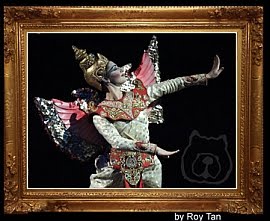
But back to Siam: fittingly, in the same performance, the famous subversive ballet reinforced my point. Without getting into the story too much, I’ll say it ended with the dancers simulating a mass drowning by unfurling a huge swathe of blue silk over their heads to totally cover them, and at the climax, thrusting their hands through hidden holes in the silk, an instantly-recognizable symbol. It didn’t take money or complicated engineering to create, just cleverness and imagination (not to diminute the cleverness and imagination that goes into engineering, but considering how many great shows have been put on in crumbling, sub-code earthquake deathtraps, it is perhaps not the “stuff” of great theatre, unless you’re seeing a show here). The audible, and audibly delighted, gasp in the auditorium at that moment, was, I think, a greater triumph than all of the hype about the flooded stage.

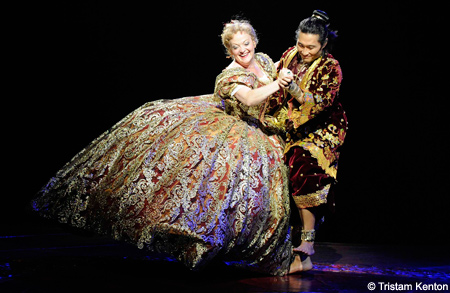
And finally, for all the extravagance of the production, the most affecting moment, and one that incited the audience of thousands to clap along, was “Shall We Dance?”—the exuberant polka that prim Anna teaches the King to dance to. Three million pounds spent on a production and the thing that gets people out of their seats is watching a couple of laughing, panting middle-aged actors gallop around the stage. It was a beautiful, joyful moment, and one in which the only sign that more money than normal was spent was her INSANE DRESS, to which photos do no justice. It was also a moment that did not invite unfavorable comparisons to Yul Brynner (except inasmuch as any comparison to His Bald Majesty in any context must be unfavorable). There’s a famously sexy moment from the movie in which the king insists on dancing as the Europeans do, “not holding two hands”—when Brynner, a masterful physical actor, extends his hand as if it were something else, and fuses it to the corseted waist of the appropriately half-beswooned Deborah Kerr. Daniel Dae Kim seemed to grab Anna’s waist out of pure enthusiasm for the dance itself and his surprise at the suddenly intimate contact, and at Maria Friedman’s visible frisson, made them both for a moment seem like teenagers, and like equals. It had a freshness that can only come from two people standing on a stage, any stage, and allowing themselves to experience something real.

I saw a performance about a year ago at NYU’s summer lab, a workshop for students and alumni of the graduate theatre programs. Everything was as minimal as could be but the talent. It was basically a beautifully written play, acted brilliantly, some of which was due to the talent and skill of the actors and some of course to the director guiding them to make each scene and its place in the story, clear. That was all. Everything else either didn’t exist or had substitutions that were chosen without any attempt at convincing replication at all. Whiskey glasses were jam jars filled with water. Shovels and shoveling were mimed. Bones and skulls were planks of wood and balls of rubber bands. Murders happened with no rupturing of cleverly concealed packets of fake blood. Sound effects were narrated by the stagehand. There was no set, just a stage painted black and a table. It was one of the best, most moving plays I’ve ever seen, and a premier example of how poverty theatre, done well in the aspects that matter (writing, directing, acting), makes a fool of spectacular theatre. I dare any proponent of the hogwash idea that great theatre requires expenditure of fortunes–and that people go to the theatre for the razzle-dazzle, or that cynical, intellectually and creatively lazy cliché, “to escape”—to see something like that and suggest it would have been a more moving experience for the audience if the actors had used real-looking bones and real shovels and real dirt and real fake blood and monstrous set pieces and marvels of engineering and Spielburgian special effects. People who see theatre like this show I saw in the grungy pit at NYU go to the theatre regularly, because it gives them something more substantial than razzle-dazzle (and doesn’t cost $125 a ticket. I’m talking to you, Broadway). People who go to the theatre for spectacle go once a year, because that’s all they need to get their fix of what essentially can only nourish a part of them that doesn’t ask for much beyond the cheap thrill of expensive pageantry. People go to the theatre to be moved in one way or another, and if the only way you are able to move them is with grandiose money-flinging and a literal-minded slavery to realism, you are doing something wrong, and should not be surprised that most people would rather stay at home and watch television.

Unfortunately the production at the Royal Albert Hall was not videorecorded; I would love to include a clip of my favorite moment, although perhaps some of the magic of the live performance would be lost in conversion. So I’m including a clip from the movie. Swoon.

Posted in ART, London, REVIEWS, theatre | 2 Comments

Hell is Your People


I got an invitation in the mail the other day to the annual “Russian Festival” at the San Francisco Russian Center, an event I attended regularly as a child. I remember tables of cherry pastries and pierogi, game stands where you could play for a quarter and win tiny plastic toys, and rather thrillingly athletic dance performances by local professional Russian and Ukrainian folk dance troupes. I also remember the weirdness of seeing my classmates from the Russian Orthodox school I attended part time in this other context, outside of school and with their families. At that age, the people in your life fit neatly into categories: there were my mother’s friends who ushered with her at the opera and always wore black, my father’s friends from Vesuvio’s, who grew their hair long and argued about poetry, his models, who were always naked and very sweet to me despite my frequent interruptions of their sittings, my friends from my regular school, who wore their hair in dookie braids and played football with me, and my classmates from Russian school, who wore navy blue skirts or pants and white blouses and were generally terrors. It was strange seeing them in normal clothing with nice grown-ups who resembled them and who didn’t seem aware of their awfulness. I assume I was awful then too, for at that age I would do anything to fit in. I even played along when they’d flip their bottom lips down and their upper lips up, a “game” we called “n***** lips”.

As she handed me the invitation (a print of a smiling Matryoshka, of course), she said that it had always been a regret of my American father’s that they had not worked harder to insert me into that world, the Russian immigrant community. This had been a platitude of my growing years, the importance of ensconcing oneself in the culture of one’s ancestry. For my parents, especially my mother, this importance had several bases, one being that one had to look outside the American mainstream for culture worthy of the name, and she had me watching Russian childrens’ shows, Russian opera and ballet, studying art, math, and chess, with teachers from institutes in St. Petersburg and Moscow (all of which I still believe are leagues superior to their American counterparts). The other was a belief that in order to assess the virtues of whatever world one lives in, and even to gain respect within that world, one has to be able to stand aloof from it somewhat, to know things, have experienced things from a different world. I still like to be a little different from whatever circles I’m moving in at the moment, and find myself emphasizing what foreignness I can lay claim to when I’m with Americans, and acting the unrepentant ugly American amongst foreigners.

Of course the modern, western affection for multiculturalism reinforced these notions, and I never thought much about them. But when my mother mentioned this the other day, that even my Midwestern American father genuinely wished he had made more of a Ruskie out of me, for the first time I considered whether I shared the same wish, now that I’m an adult. I realized that it was no longer a given that I shared the same regret. I wasn’t sure, as my parents had been, that closer ties to the Slavic community here would have been a boon to my life. How, exactly?

A couple of days after that, I went to the Russian deli in the Outer Richmond and ran into an older male acquaintance—I say acquaintance although he was as good as a stranger to me, but seemed to know my mother. He spoke to me in Russian and I had to tell him in the few broken words at my disposal that I only understand a little, and speak badly. He looked crestfallen, stunned, bewildered at both my ignorance and my willingness to admit to it. He had a friend of his own with him, who was definitely a stranger to me, and who asked,

“Don’t you speak any other languages??”

“French.”

He looked off into the pickle shelves and then down at the floor, as if he might find the reason for my having wasted my life like this spelled out in the squashed caviar along the linoleum.

He looked back up at me, a scowling acheiropoietos, and said,

“It would be good to have….something else.”

I’m never as offensive as I want to be in the moment, so I replied with a curt, “Yes, it would” and walked off wondering how much more connection to my people I could stand. This incident on its own is of course unimportant; who cares what these alter kakers think? Let them wear their Texas cowboy hats and vote Republican and believe themselves more erudite than the spoiled layabout natives of their adopted country. But the incident is not unusual; all my life our Russian friends, and not only friends but strangers we met for the first time, like this man, have felt it’s ok to criticize as insufficient the education I was and was not getting from my parents. They felt it was ok to interrogate me as a child, and to criticize my mother to her face for not making it easier for gems like them to talk to me. The arrogance, the bald-faced rudeness, the presumption, but more than that, the supernatural patience and decency of my mother to refrain from telling them (in English) to fuck off back to bloody Odessa, or Novro-piss-sick, or Nouveau, New-Mafia Moscow, to go shoot a journalist or neglect a nuclear plant or bomb an orphanage or do fuck-all about sex trafficking or whatever our people are up to these days besides berating second-generations for not wanting to be more like them.


When I was younger, it always bothered me, but only as a well-aimed accusation. I felt they were right, their accusations righteous, and was ashamed of myself for not having tried harder to become more like them. But now I see that I can go ahead and be ashamed of them instead. Ruder and drunker than the British, more racist than the Confederacy, more arrogant than the French, more maternally-smothering than the Jews or the Chinese, tackier dressers than new-moneyed Italians, as untrustworthy as any souk pickpocket, as superstitious as Gorky’s peasants. And how do we explain the utter lack of regard for their own? There are Russians, millions of them even, who still mourn the death of Stalin, the outperforming autogenocide. When Moscow has money, it builds new towers and embellishes its squares and lets orphanages, hospitals, and asylums rot.

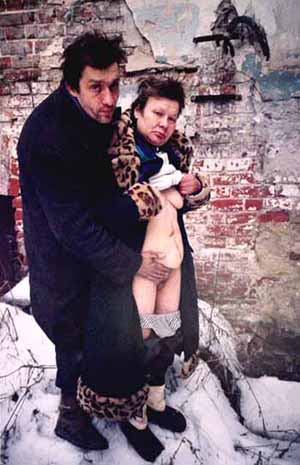
This is the work of Ukrainian photographer and documenter of post-Soviet wretchedness, Boris Mikhailov. Go ahead, do a google image search. I fucking dare you.

There’s a quotation from Dostoevsky that has been bastardized to read, “It’s easy to love mankind. It’s hard to love a man.” I think I can further bastardize it to say, “It’s easy to love your culture, but hard to love the people in it.” I’m thought a Russophile by everyone who knows me, and to an extent, it’s true. Most of my favorite works of art, in every medium, are Russian in origin. And the more I learn, the more I see that to get training of any seriousness in so many of these art forms, you need a Russian teacher. How sad it was to visit the great Pinacoteca in Milan, and study the art projects of its graduating students, and see that they haven’t learned even the basics of rendering the human skeleton, something I had mastered by age eleven with my teacher from Petersburg. Watch the Kirov do Swan Lake and then watch any American company do it; there is no question of the superiority of the training dancers receive at the Vaganova School. Sorry, ABT. The few weeks I spent in Moscow I still consider to be the best and most concentrated theatre training of my life. My favorite movies, my favorite operas, my favorite painters, actors, writers, poets, my favorite cities with my favorite architecture, my favorite pastries and soups and wines and garlic zakousky, my favorite sacred music and dirty jokes, all Russian. Yet I don’t perceive a connection between any of this and the gauche, heavy-handed, heavy-bottomed, boorish examples of this people that I meet and interact with in my day-to-day life. Have you ever been hit on by a Russian man in his twenties? Have you ever had to do business with a Russian? Did you ever get your money back?

This is all very grim for me to be thinking and saying. I will leave you with a video from my favorite cartoon series from my childhood. It’s called “Nu Pogodi!” or “Well, just you wait!” The wolf (the bad guy, not only morally bad but ill-kempt and uncouth) always pursues the rabbit (good and neat and classy). I watched this incessantly as a child. I cite it as an example of superlative Russian children’s television programming because along with being hilariously entertaining, it always slipped in high-cultural references, thereby sneakily teaching us about art while we thought we were just goofing off. My first exposure to Swan Lake was in this episode (around 4:30). Later, around minute 9, the wolf does a brilliant impression of the great subversive singer Vladimir Vysotsky, so beloved of the people that even the Soviet government couldn’t touch him. The second video down is just damn funny.


Posted in my neuroses, Russianism | Tagged , , | 7 Comments

Eonnagata, Théatre des Champs-Elysées

Another piece I was lucky enough to see in Paris was Eonnagata, a collaborative dance/dramatic work by Robert Lepage, Sylvie Guillem, and Russell Maliphant, at the Théatre des Champs-Elysées.

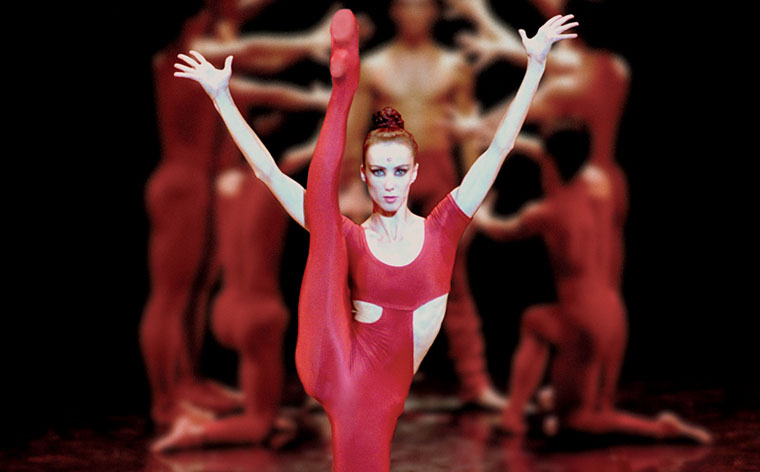
Now, I say lucky because I will happily see anything with Sylvie Guillem, of the world’s best legs and worst haircut, although much of the work she’s devoted the post-classical stage of her career to puzzles me somewhat, including this one. Eonnogata concerns the 18th-century diplomat and spy, the Chevalier d’Eon, a famous cross-dresser and possible sufferer of Kallimann syndrome, which prevents the body from developing past puberty. The –“agata” bit came from “Onnagata,” male kabuki dancers trained to perform female roles. Robert Lepage is a noted Quebecois author and director of opera and theatre. He is also 54 years old, thick-waisted, sluggish and I can only assume has bollocks like a woodland caribou. The piece opens on him slashing at the air with a sword, lagging behind the crashing sounds which I suppose were designed to supplement the ferocity lacking in his presence, just as the choppy lighting effects almost mask the phlegmatism of his movements. Maybe he figured that what the greatest dancer of her generation and icon of French sexiness needed was to top off her career by sharing the stage with a pudgy, aging Canadian opera director. The piece proceeded to alternate between superficially realized Japonesque posturing and Rococo embellishments to a lot of incomprehensible storytelling.
I thought at first that I was witnessing something truly bizarre and was pleased that the days of having to go all the way to Paris to see something so outré were not over. Just trying to make sense of what was going on and why the worlds of the French transvestite and the Japanese drag artists were presented together, as if their combination offered something more than the obvious parallel, kept me engaged throughout the entire 90 minutes. But it turned out to be the usual gender-identity stuff. I felt I was watching what happens when people are powerful and successful enough to indulge their fetishes on a grand scale, that Guillem had the usual westerner’s cursory fondness for eastern kitsch, and that Lepage wanted to get to wear kimonos and lace bonnets onstage.
It’s not that it was unpleasant, although I didn’t exactly enjoy it. Eonnagata makes me wonder why she’s focused her formidable talents on works that don’t show them off particularly well. I have seen her a few times since she visited San Francisco in the late ‘80’s with La Bayadère and made the audience gasp as she caressed her own ear with her calf. She has since abandoned the classical repertoire for the modern. I can understand her wishing to discard relics like Bayadère, which didn’t really do her physique or extraordinary skills justice either—those works were originally created for dancers of much lesser abilities, whose training in no way matches the training of dancers today. It’s unlikely that Marius Petipa would have ever even seen a dancer with the kind of arches, extension, and jumps that the average corps dancer today has, and Guillem looks like a being from a superior alien race even amongst today’s most gifted dancers. While an artist like her can make those ballets look as alive and interesting as they ever will, watching her (on youtube, since her rejection of the genre includes refusing to release the films made of her in those roles commercially, and the only clips one can find are from people who managed to videotape the productions when they were broadcast) one wishes she would just break out of the tutu and abandon all the silent film hammery. Neither does the classical repertoire allow a dancer to remain in the game for as long as she has, and probably will—pointe-work is for younger bodies. So it makes sense that she would have left that genre for something more diverse, modern, and challenging to her, and better suited to her cold and slightly threatening stage presence than the blushing virgins and heartsick peasant girls that populate classical ballet. But I’ve found that what you get when you see a Guillem piece these days—and it is always a Guillem piece if Guillem is in it, regardless of what stocky clay-foot she’s using as furniture at the moment—is a little bit of Guillem and a lot of disappointing other stuff.

Her latest partner is the respected dancer and choreographer Russell Maliphant. More studied dance aficionados than I hold him in high esteem, but I do not see what they see, and I can’t help but think that Guillem has not only advanced his career by miles, but also elevated his art from the pedestrian and forgettable to the stratospheric by allowing him to attach himself to her. Of course I feel the same way about the great Joan Baez lending her divine voice and phrasing to an entire album of songs written by that smug twerp she dated in the early sixties, so take my opinion with a grain of salt if you want. As far as modern choreographers go, Maliphant’s work is fine, although I’m not sure it will place him in the pantheon of greats like Bausch, Tharpe, Ailey, Bejart, Cunningham, or Boris Eiffman. Maliphant is not to the world of choreography what Guillem is to the world of dance. And as a dancer, well, he’s short and has a big head and short limbs, like an unusually graceful rugby player. Some admire the athletic recklessness of his style, and fair enough, although when I’ve seen him he has seemed self-contained to a fault, and I wished he really would give off a sense of that athletic recklessness which is often touted as a perfect contrast to Guillem’s smooth exactitude. But again, he’s not to the world of dance what she is to the world of dance. He’s a very accomplished and very capable British dancer and she is the French alien with the unthinkable legs and criminal feet, in her time the most highly paid ballerina in the world, the press’s “Mademoiselle Non,” the Monstre Sacré who dismissed Paris Opera Ballet and its director—Rudolph Nureyev—as too provincial for her ambitions. I find the contrast between them painful to watch, and I want to console him afterwards. Imagine how I felt when both Maliphant and Guillem left the stage to Mr. Lepage.
Basically, I just don’t see what she gets out of the collaboration. More troubling, I don’t see what her audiences gets out of it, either.
I’m including some footage of Guillem at work, hopefully to show that the merits of her dancing are not merely gymnastic. The extreme arch of her feet, her shocking extension, the sense that she can perform even rapid movements smoothly and gracefully (where lesser dancers seem to have to choose between rapidity and grace)—all serve an expressive purpose, an artistic one beyond merely showing off. When the lines of the body can create a visual illusion that they go on farther than they do (and this, I think ,is the sought after effect of the physical elements considered virtues in ballet, which Sylvie Guillem possesses in spades—the fluid arch of the back and the leg stretched to hyperextension rising to a crest in the arch of the foot), the effect is both thrilling and strangely moving. It’s not just a matter of gawking at someone who can literally kick herself in the face. Dance, like verse drama, is a heightened portrayal of ourselves. In verse drama, we speak better than we really do in order to convey truths that paltry realism can’t carry. Shakespeare tells the truth about us more clearly than our own stammering, clunky inarticulateness ever could. It’s not “realistic” in that we can’t just yammer on and come out with the St. Crispin’s Day speech. But it’s real, as anyone who’s read or heard the speech and felt his throat clench and eyes well up knows. In dance, we need to see the body be more than it is in real life—longer, more graceful, more taut, more expansive, more able to move beyond itself—to perceive what it has to say. Buried in our natural oafishness is the ability to speak through our bodies, to say I am afraid, I am proud, I am sad, I am happy, I am horny, I love you, I want to kill. Dance, at its best, reminds us of that, because when a dancer is conveying these experiences we experience them along with her. And what do we go to the theatre for if not to be moved?


Posted in ART, ballet, damn good, dance, my travels, Paris, REVIEWS, rude french people | Tagged , , , , | 4 Comments