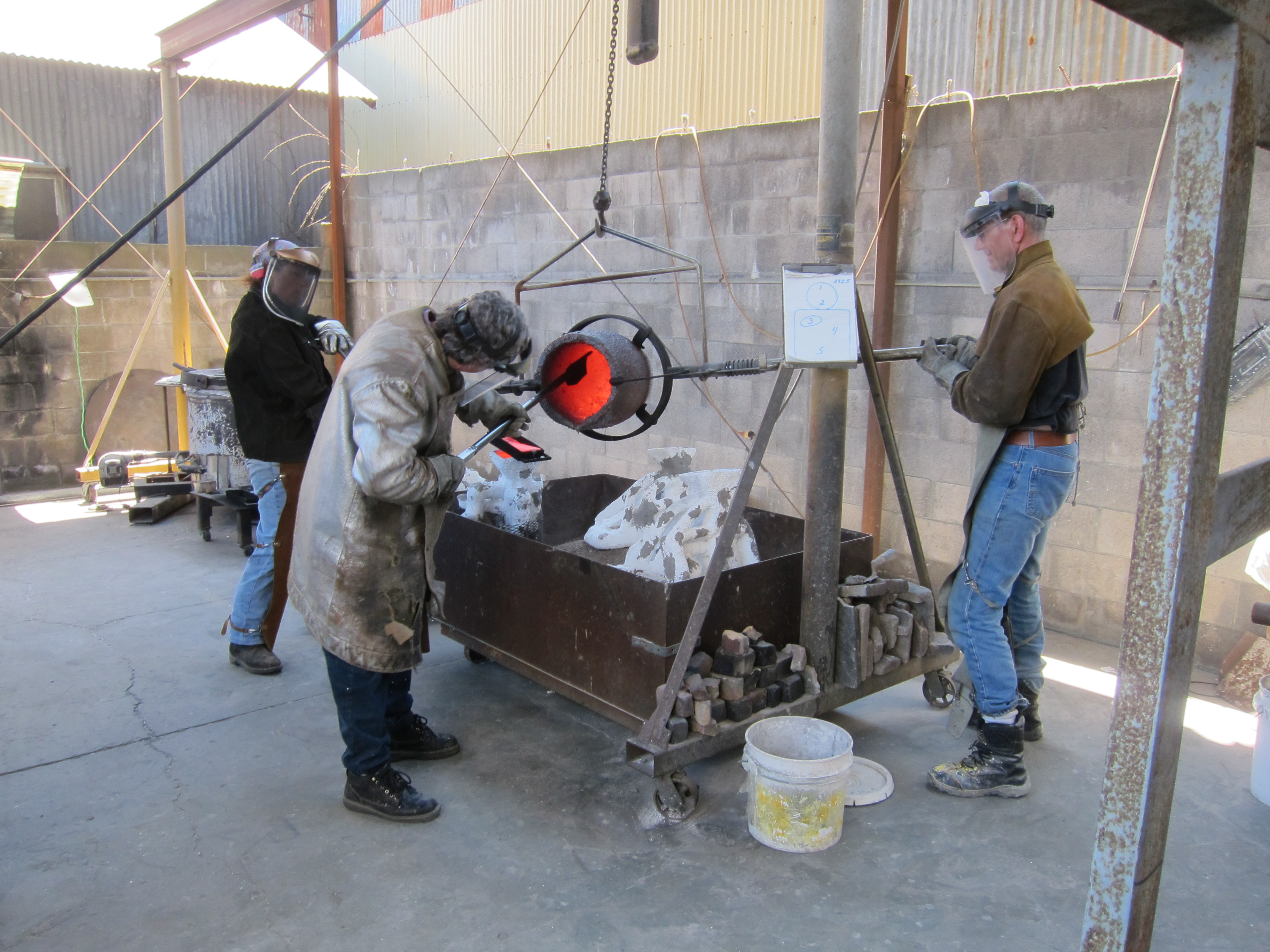
I visited the foundry with bronze artist Randy Colosky. SF Weekly.

The balance between function and concept is rarely straightforward in the work of Bay Area artist Randy Colosky. He’ll take the process of bronze manufacturing, usually concealed as the “behind the scenes” element left invisible and unsung in the finished creation, and bring it to the forefront. The industrial elements of bronze lost wax casting take on new aesthetic and conceptual weight, with gates and sprues (the pre-made wax forms utilized as melt-away shape holders that create passageways in the mold for the molten metal to flow through) visibly repurposed into the shape of the sculpture itself. Colosky also plays with trompe l’oeil, making convincing cinder blocks, bulging foam stuffing, books, and more out of bronze (and admits to enjoying a chuckle when people actually mistake one of his sculptures for some misplaced object of the more banal sort he modeled it after).

not books.

The results are often witty and provocative, requiring double- and triple-takes to even get a literal idea of what they are (as in, first you try to pick up one of those books, realize it’s as heavy as, well, bronze, and then laugh at yourself for not noticing the unlikeliness of a title like “The History of History: What Happened.”) The robust, abstract forms he creates from the tools of bronze casting invite reconsideration of what constitutes the merely functional as opposed to the aesthetic. (continue reading)

Posted in ART, San Francisco | Tagged , , , , , , | Leave a comment

“See yourself seeing yourself” with Outerbody Experience Lab.

Sometimes you’re sitting in the sun in Dolores park and you’ve had half a beer and you see this dancing robot with music blasting out of its thorax and you’re given a pair of weird goggles and told that if you wear them while dancing with the robot you can see yourself dancing with the robot, so obviously you strap them on and start getting down with your bad self.

Right?

San Francisco startup Outerbody Experience Lab offers the opportunity to see yourself from a third-person perspective–basically, you are filmed while performing some activity (like dancing with robots) and in the goggles’ field of vision you see yourself from the perspective of the camera. Their website explains:

Your visual perspective has a lot of influence over how your mind fabricates your own sense of self. In this fractured sensory state you’ll have the opportunity to sample a handful of activities and games that accentuate the balance between your eyesight and your other embodied senses. The goal is to relocate your sense of self out of your body.

Their promotional event yesterday was a one-off, although the dancing robot is a regular and has become somewhat of a Dolores Park institution, but OEL offers 15 minute or one hour studio sessions or can do on-location events like parties or yoga classes, all customizable for whatever you want to watch yourself doing. My guess is it won’t be long before they have to insert a “no porn” clause into their terms of service.

I had trouble making the goggles fit my head, and so sometimes couldn’t see anything at all. When I could see, I couldn’t actually tell whether what I was seeing was the negative image of what was going on (meaning whether the movement on the right of the screen was actually happening to my right or to my left and vice versa), and there was a bit of a drag, which was disorienting indeed. I’d be flailing my arms and see myself still shimmying my shoulders as I had done a moment before. Then since all of my actual vision was obscured I couldn’t tell where the camera was, so when I left the frame and could only see the robot or the other dancers, I didn’t know which direction to move in in order to re-enter the scene. And all the while I had a nagging worry that I was about to tumble to my death down the gentle incline of the grassy knoll. But it was still quite fun, and I think, a worthwhile experiment in literalizing the effect of “watching yourself,” so often derided as the death of spontaneity and the creative impulse, on your behavior and actions.

Here is yet another perspective on the experiment, that of my friend Jessica and my iphone. I take no responsibility for my dancing here. Like I said, half a beer, disorientation, blindness, fear of grassy death…definitely watch it on high def (HD 720); my ridiculousness is at its clearest thus. You may commence laughing now.

Posted in ART, experimental, San Francisco | Tagged , , , , | 2 Comments

Feedback as Music, “Tron” as prophesy. Southern Machine Exposure Project. Art Practical

On Saturday, June 30, Wobbly’s aural installation complemented Jason Brown’s witty lecture by juxtaposing visceral and intellectual responses to our increasing comfort with technology’s escalating presence in our lives. Wobbly (a.k.a. Jon Leidecker), focusing on feedback as the “intrinsic voice of electronic music,” improvised an audio set exploring the similarities between birdsong and feedback but offered no theories on why these similarities exist. Feedback doesn’t sound any different or better when created deliberately than it does as a nasty fluke of a badly arranged sound system, and all the drugs in the world would not have killed the necessary number of brain cells to allow a visitor to comfortably enjoy the session. But persistence (or the sense of obligation to stay with the hosts in their home rather than leave when the going got tough) revealed that the sounds that we associate with chaos and horror are the sounds created by malfunctioning technology. No lion’s roar or rolling thunder or crash of waves could sound as frightening and alienated as the hissing, churning, crackling arrhythmic mess of out-of-control machinery. (continue reading; this review is part of a group addressing a series of events and mine is towards the bottom)

Posted in ART, Music, REVIEWS, San Francisco | Tagged , , , , , | Leave a comment

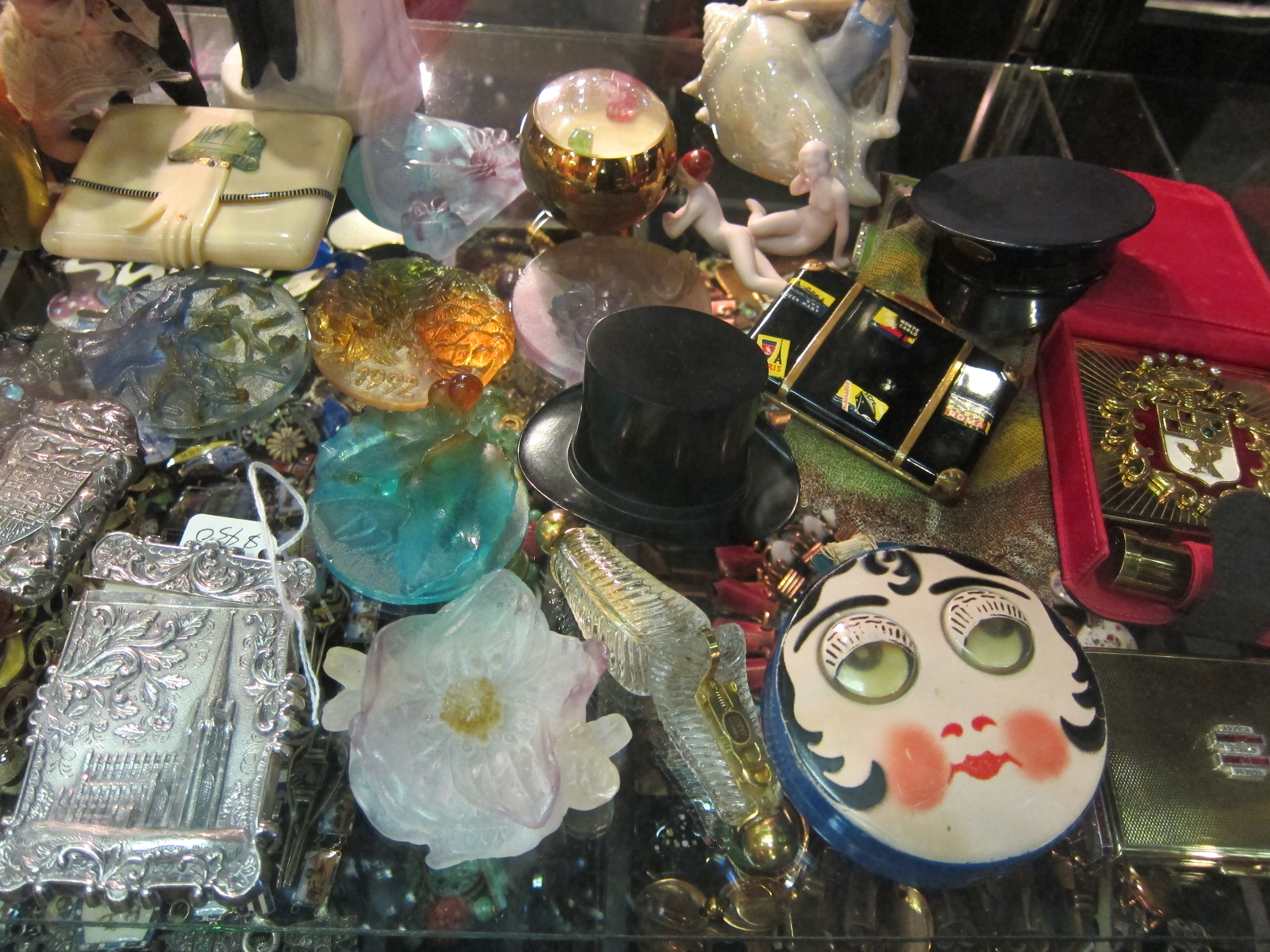
Photos from the San Francisco Modernism Show, SF Weekly

classy chachkas.

A few times a year, a massive expo is held at the Concourse Exhibition Center, where you can get a hands-on, visually exhausting crash course in the near-past’s fabulousness. Last weekend saw the SF Modernism Show, a twice-yearly event featuring many of the same vendors as the Vintage Fashion Expo. These exhibits are better-curated and glitzier (i.e. pricier) than your average flea market, but unlike the costume exhibits at museums, here you can touch, and even try on, the wares. We promise that you would be permanently banished from the de Young if you tried that on its current Gaultier exhibit. Here are some examples of the goodness we found:

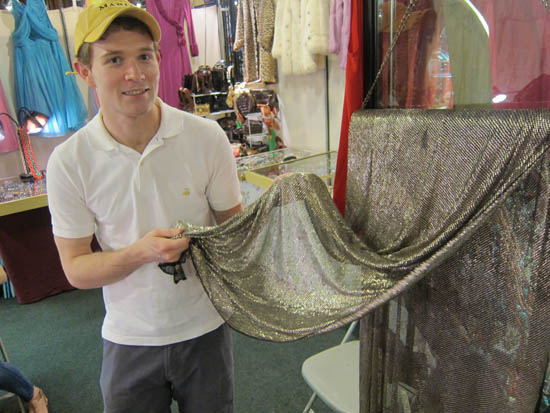
This was an example of an Egyptian shawl, or “Assuit,” named for the region it comes from. Assuit is cotton or linen mesh and thin strips of metal folded and bent (sometimes with the maker’s teeth!), into the open work. Depending on the wealth of the owner’s family, the metal can be tin or silver, and for a time it was the only thing a woman could legally own. If her family or husband threw her out for whatever reason, she could melt the piece down to sell its metal. Silk’s got nothing on Assuit as far as the shimmering, sensuous way it drapes over the body’s curves — the weight and shine of the metal scraps give the illusion that the wearer is so hot her clothes are literally melting. Some Assuits’ metalwork is embedded into them to form geometric designs; this one is unusual for the entirely pervasive metalwork, making it heavier, shinier, and significantly more expensive than its peers.

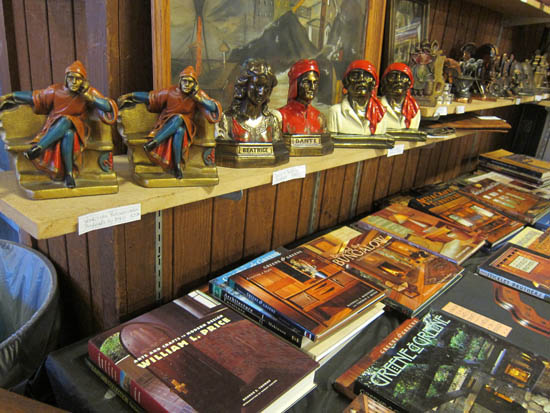
A one-stop shop for art book geeks, Miss Twist offered a range of books on art and architecture, as well as fabulous, clever, and literary-themed paper weights. We loved the Dante and Beatrice pair right.  (continue reading) 

Posted in ART, damn good, EVENTS, San Francisco | Tagged , , , , , , | 1 Comment

I had problems with “Real to Real: Photographs from the Traina Collection.” Art Practical

Martin Parr. Fashion Shoot for Amica, New York, 1999; lambda print; 50 x 41 1/2 in. Courtesy of Stephen Daiter Gallery, Chicago. © Martin Parr.

Real to Real: Photographs from the Traina Collection is flush with recognizable images, and for those who have only seen reproductions of them in books or online, the show is a necessary pilgrimage. In fact the exhibit can at times feel like a greatest-hits survey of the past eighty-odd years of photography, filled with works by such giants as Diane Arbus, Stephen Shore, Lee Friedlander, Robert Frank, William Eggleston, Paul Graham, Nan Goldin, Larry Sultan, Cindy Sherman, Alec Soth, and many others.

Images of tract housing and vast, sunbaked landscapes by Garry Winogrand, Robert Adams, and Joel Meyerowitz capture a peculiarly American sense of loneliness that we associate with space and sprawl. Several huge Andreas Gurskys must indeed be viewed in person and preferably with a stepladder and magnifying glass. Two of them, Dortmund (2008) and Union Rave (1995), display multitudes of people reproduced at a large enough size and with enough detail that one can actually examine their faces. Particularly compelling is Union Rave. At first, one sees a forest of flailing arms, but out of this mob emerge individuals whose faces telegraph all sorts of states that invite a viewer’s curiosity and even empathy: perplexed, sad, ecstatic, contemplative, giddy, nervous, stoned. It’s a reminder that “mass of humanity” is a lazy, meaningless phrase.

Such a varied collection filled with so much star power raises two interrelated questions: Does the way the photographs are grouped illuminate or obscure their riches, and how well is Trevor Traina’s private taste translated to a public venue? The curators Julian Cox and Kevin Moore (who is also Traina’s art adviser) have attempted to create a sense of cohesion by grouping works in separate rooms and cataloguing sections according to categories that combine conceptual themes and areas of technical experimentation: “Everyday,” “Excesses,” “Spectacular,” and “Losses.” But these categories—and why certain photographs were placed into each one—could be confusing to anyone not schooled in both the history of the medium and the received critical interpretations of the artists’ works, and possibly to those who are schooled, as well.

Garry Winogrand, Albuquerque, New Mexico, 1957. Gelatin silver print
8 5/8 x 13 in. (21.8 x 33.1 cm) © Garry Winogrand, courtesy of Fraenkel Gallery, San Francisco

For example, a visitor entering a room with Excesses emblazoned above the door, seeing a Cindy Sherman circa 2002 staring from the opposite wall and placed next to Gursky’s Dubai World 1 (2010)—knowing that, until recently ousted by Gursky, Sherman held the world record as the photographer whose work had sold for the most money—and seeing Bette Davis (Pictures of Diamonds) (2004), Vik Muniz’s image of Bette Davis made from diamonds, close by, might assume that the selection is a topical grouping that addresses themes concerning money and extravagance. But here, excesses refers to the abundance of experimentation within the medium. Rather than empirical representation, these images are of self-consciously staged, altered, and/or manipulated pictures. (continue reading)

Posted in ART, photography, REVIEWS, San Francisco | Tagged , , , , , | 2 Comments

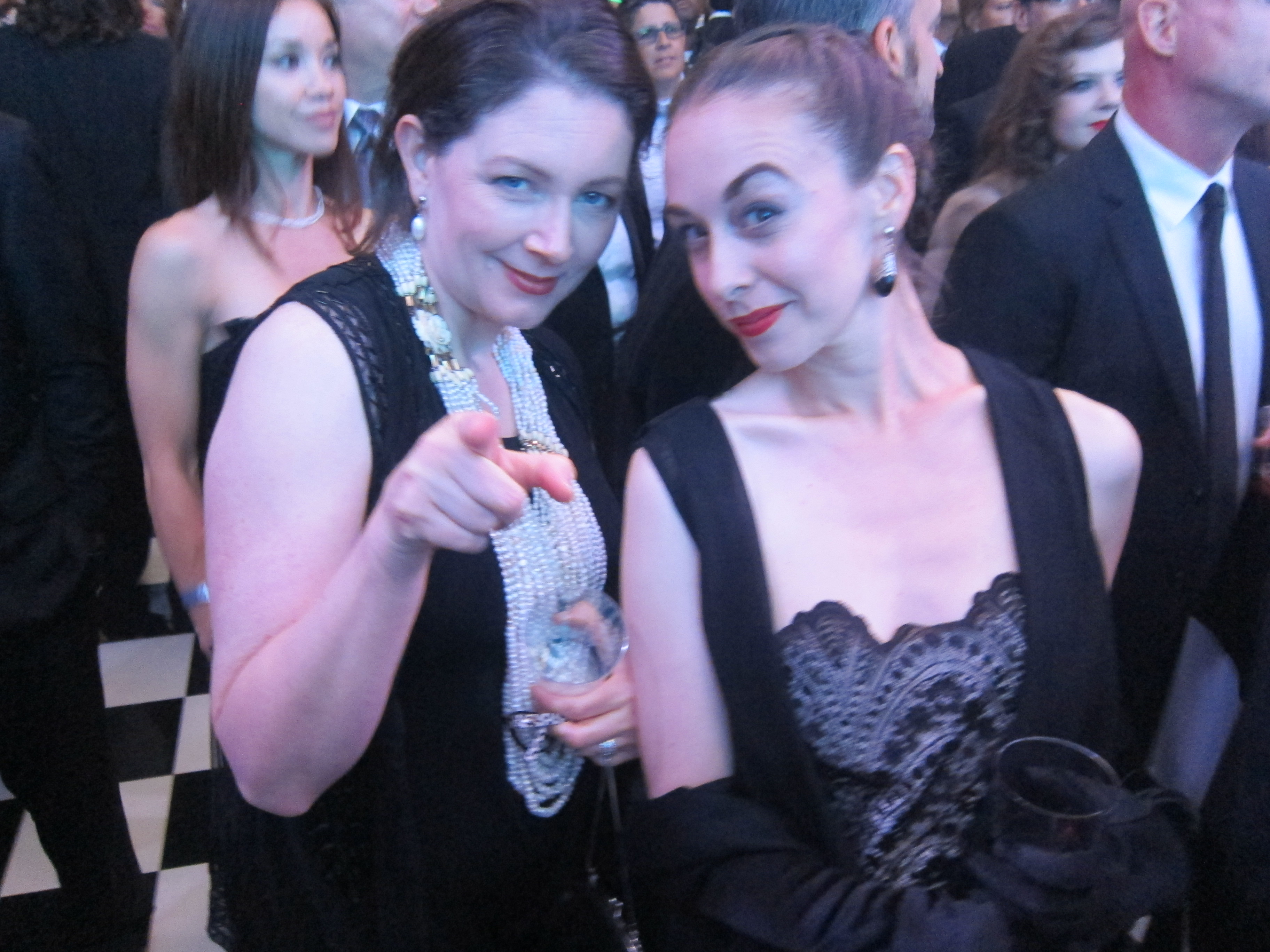
My feet hurt so good after the Black and White Ball. SF Weekly

I previewed the great San Francisco fête here:

If it’s June and after dark, and you see women tottering around Civic Center in gowns with color palettes from silent films and their dates’ tuxedo jackets on their shoulders, you’ve probably wandered upon the San Francisco Symphony’s biannual Black and White Ball. Preceding by a decade the identically named “pinnacle of New York’s social history” (Truman Capote’s famously lavish party at the Plaza Hotel), San Francisco’s Black and White Ball adds philanthropy to its hedonism — for more than 50 years the ball’s proceeds have supported the symphony’s robust music education programs, which benefit some 75,000 children each year.

…and here are my thoughts after attending:

A great party, whether it’s a few friends chowing on Smack Ramen and Schlitz in a dorm room or a high-ticket spectacle that takes over the center of a major city, is a work of art. It’s no small thing to orchestrate the convergence of personalities, guarantee security, book the entertainment (if the scale allows it), satisfy the talent’s whims, estimate and provide ample food, drink, and toilet paper — and to conceal the OCD detail-fixation necessary to pull it all off so that it doesn’t look and feel as regimented, micromanaged, and like it’s from beginning to end on the verge of collapse, which it definitely is. It requires, as insensitive stereotypes would have it, Italy’s sense of fun, Germany’s discipline, and Russia’s pessimism. It’s why successful party planners are paid 1-percent-worthy fees.


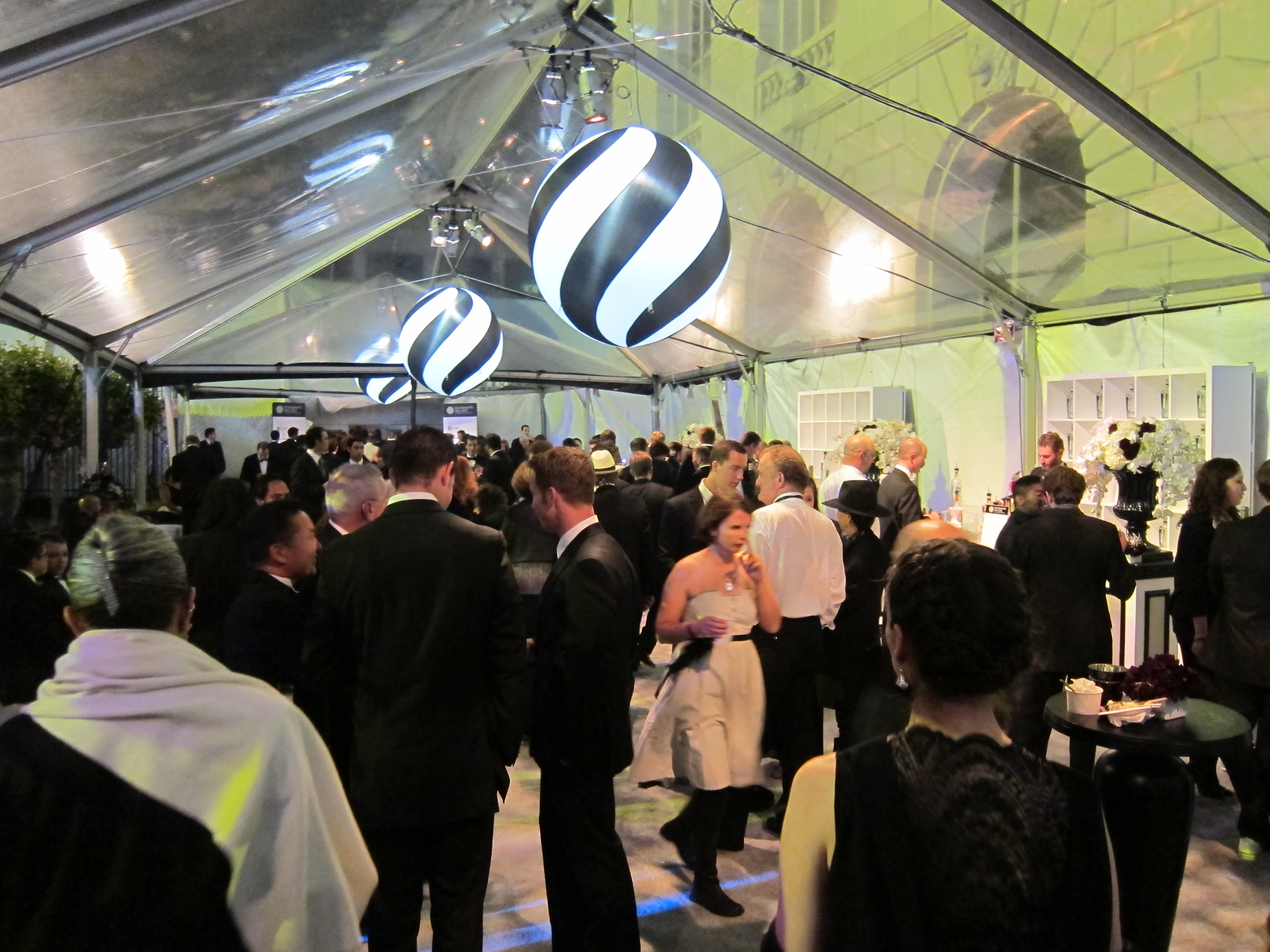
Saturday’s Black and White Ball, the ne plus ultra of Bay Area fancy dress fun, demonstrated this to dazzling effect. The festivities, tickets to which started in the hundreds of dollars, occupied (ha!) the War Memorial Opera House and the stretch of Van Ness between Grove and McAllister. Depending on one’s musical tastes, at any moment one had several bands to choose from playing outside or in the halls and tents erected for the event. Munching on dim sum and making pitstops at the bars stationed every four or five feet, one could drift from salsa in Herbst to a funk band in City Hall, or see Janelle Monae in the Tent Pavilion or stand outside and watch Cyndi Lauper do a somewhat less-energized performance than what we ’80’s babies remember her for.

Despite the crowds there didn’t seem to be any particularly long lines for anything but City Hall’s women’s room. Bins for garbage, recycling, and compost were easy to find, and there were plush couches to sit on and people-watch when your feet got tired. The colored lights beaming from City Hall through the fog made Civic Center look like a Monet painting, and when clouds of white confetti were released for the midnight surprise, the lights shining off them as they spun and floated to the ground made it seem like all of San Francisco had been glitterbombed. It was cold out, but the tents were heated, and if you kept dancing, even outside you could stay cozy.

Janelle Monae

The midnight surprise itself was a moment of tear-jerking, unabashed city spirit, as motorized cable cars rolled down Van Ness carrying gleeful mimes and dancers in lobster costumes, who spilled out and induced, by sheer force of cuteness and puppy-enthusiasm, even the squarest couples to dance like no one was watching (which everyone was, on giant screens, and pointing and taking pictures and uploading to the internets — or was that just me?), as Glide Memorial’s choir sang. (continue reading)

Posted in damn good, EVENTS, Music, San Francisco | Tagged , , , , , | Leave a comment

I talked with Lysley Tenorio, author of (fab!) “Monstress,” for Zyzzyva

monstress The people of Lysley Tenorio’s story collection, Monstress (Ecco), are straddlers. Most obviously, they straddle cultures. Filipino immigrants in America pine for their native land or wish, often hopelessly, to assimilate indistinguishably into the culture of their adopted home. Life in the Philippines seems just as conflicted; the West’s exported culture muscles out the endeavors of Filipinos, with the Beatles and Hollywood dominating the collective imagination there just as much as they do here.

But Tenorio’s characters also seem to straddle the high and low. He imbues them with profound (but never cheaply sentimental) longings, and with refinement of feeling and self-awareness worthy of poets — while simultaneously placing them neck-deep in kitsch, dragged down by, or simply muddling through, risible circumstances. The world they move in is one of hilariously awful B-horror flicks, faith-healer quackery, cartoon super villains, delusional celebrity-worship, exploitative daytime TV. Yet behind his characters’ preoccupation with low culture, their inner lives couldn’t be more humane, or deeply humanistic: there’s tenderness toward a mother beset by alcoholism and bad judgment, (and a precocious awareness that that tenderness is deformed by its futility), the guilt of knowing one could have been kinder to a troubled sibling, the giant-hearted, doomed bravery of a love affair between two people who know they can never be together or even look upon each other.

Monstress does what all the best art does: it reveals the nuanced depths of people one might otherwise overlook or casually judge and dismiss. And it does this without polemic or the tiresome earnestness some writers succumb to when doing or attempting to do the same thing. There is as much humor in Monstressas there is material for a good cry.

I talked to Lysley Tenorio via email about Monstress and about his life as a writer. (continue reading)

Posted in ART, books, Interviews, San Francisco, Uncategorized | Tagged , , , , , | Leave a comment

Robert Reich spoke with City Arts and Lectures

It was hard to gauge whether anyone who attended Robert Reich’s City Arts and Lectures talk at the Herbst actually learned anything from it, or had hoped to. Given the city, and the politics of the speaker, and the audible hissing at every mention of Bush, Citizens United, the Bush tax cuts, Goldman Sachs (you get the idea), it didn’t seem like the audience included very many people who had come seeking to be dissuaded of their right-wing convictions. A less benign line of questioning from the interviewer, former UC Berkeley law professor Roy Eisenhardt, might have yielded some insights one couldn’t necessarily have surmised from Reich’s frequent contributions to NPR, TV appearances, his 13 books (for them what’s read ’em), or many published articles, but the discussion did remind one of how rare it is to witnesses a dialogue of such length and civility, regardless of ideological bent. Indeed, the ideas expressed onstage that night didn’t get much more inflammatory than, “It’s all Reagan’s fault.” (spoken in jest. maybe.), “Supply-side economics is a religion as is its sister, austerity economics,” and “How stupid do you have to be to vote down something that would keep student loan rates low?” Much of what Reich expressed sounded, well, sound, but without pressure from his interviewer to support his views more rigorously, the assumption seemed to be that there was a tacit agreement amongst his audience on what the facts were and that analysis of them, or even just common-sense consideration of them, would lead anyone to the same opinions. Perhaps this suited most of the listeners; the ones who participated in the Q&A period afterwards seemed well-versed on the subject (and there was a somewhat depressing, noticeable difference in the incisiveness of the questions from this audience and ones asked at artist-talks). But if one was hoping to glean something to supplement what one learns from the various most popular modes of passive consumption, cable news, its derivative satires, ideologically-emphatic podcasts and short-form opinion pieces, the effect of the talk was more a revelation of one’s intellectual laziness than an educative dialogue for anyone not already well-informed.

In other words, I, who have only ever read The Economist while drunk on Eurostar champagne (both complimentary in business class), left the talk understanding little more about economics than I came in with, save the unwelcome realization that the burden of educating me was on me, and not on Robert Reich.

City Arts and Lectures hosts conversations and lectures by fascinating people at the Herbst Theatre in San Francisco’s Civic Center. I recently saw the eloquent and deeply charismatic photographer Sally Mann discuss her life and career, accompanied by a slideshow of her hauntingly beautiful, controversial photography. Upcoming speakers include The World According to Garp, A Prayer for Owen Meany and The Cider House Rules author John Irving (May 22), New Yorker cartoonist Roz Chast (June 5), General Colin Powell (June 7), and photographer Richard Misrach (June 4). Of course it’s a treat to get to sit in the elegant Herbst Theater, surrounded by Frank Brangwyn‘s murals, but when the Herbst closes next year for renovations, it will also be great to finally attend the Nourse Auditorium in the capacity for which it was built. In a disgraceful misuse of the facility, the city has for decades used the Spanish-Revival building as a storage facility for the San Francisco Unified School District. Let’s hope that this marks the house’s permanent return to its intended purpose.

photo by Roslyn Banish

Posted in EVENTS, REVIEWS, San Francisco | Tagged , , , , | 1 Comment

I interviewed Dita von Teese for The Rumpus

photo by Alert Sanchez

Dita von Teese, burlesque superstar, author, actress, costume and lingerie designer, and formidable businesswoman, is idolized by many who might not otherwise fancy themselves enthusiasts of burlesque, let alone openly admire a star of “adult entertainment.” She has revived both an early incarnation of her art (even the “tease” in “striptease” seems charmingly antiquated by standards shaped by Hustler and the Internet-driven ubiquity of porn) but also an aesthetic, a mode of comportment that harkens back to a time when women went to finishing school and learned to dress, pose, sit, walk, gesticulate, speak, and even laugh with a certain delicate restraint. It’s an aesthetic wherein a woman’s dignity is an integral part of her sexual allure, rather than a thing to be sacrificed in pursuit of sexiness.

Von Teese’s burlesque performances and her vast body of work as a model (for which she has maintained both artistic and financial control, designing and copyrighting the images) are marked by a playfulness that never gets sloppy, a sensual and sexual openness that never succumbs to the crass: in her most outré moments one can’t quite imagine her doing anything “obscene.” This juxtaposition of the high and low art, the very artfulness itself, has made Von Teese the most celebrated burlesque dancer in the world, and gained her fans of both sexes, even made her an unlikely feminist idol.

photo by Albert Sanchez

The Rumpus: How do you rehearse? How much of what we see onstage is improvised?

Dita von Teese: It depends on the act. Some are very precise and more tightly choreographed than others. Others are not so much apart from hitting certain marks and parts of the song, because the sizes of my stage vary so much that I have to be ready for anything, to work with a new space. Plus with the complexity of most of the costumes and the way they come off, there’s got to be a little leeway in the choreography.

Rumpus: One thing people often remark on regarding your work, and the “vintage” burlesque it harkens back to, is that it is so elegant, playful, and even innocent compared to many of today’s forms of titillating dance performance and stripping. Why do you think “adult entertainment” has diverged from the ladylike to this much more overt (perhaps even humorless and literal) and pornified manifestation? Or is it a mistake to even analogize today’s adult entertainment with burlesque?

von Teese: It’s all relative. To relate adult entertainment to burlesque, because that’s what it originally was in the 1930s—titillating entertainment for adults. I don’t romanticize the past much when it comes to this subject, because one could buy hardcore porn, heavy bondage and fetishistic erotica from the time the camera was invented. It’s always been there, and some people have always wanted it; it’s just that nowadays it’s easier to find it. People are people and have always had these urges and fascinations with sexuality and even extreme sex, so I think it would be a mistake to say things are so different now. It’s only different because we are freer to be how we want to be publicly. We also have more access to erotica due to the way technology has changed. (continue reading)

Posted in ART, burlesque, damn good, dance, Interviews | Tagged , , , , | Leave a comment

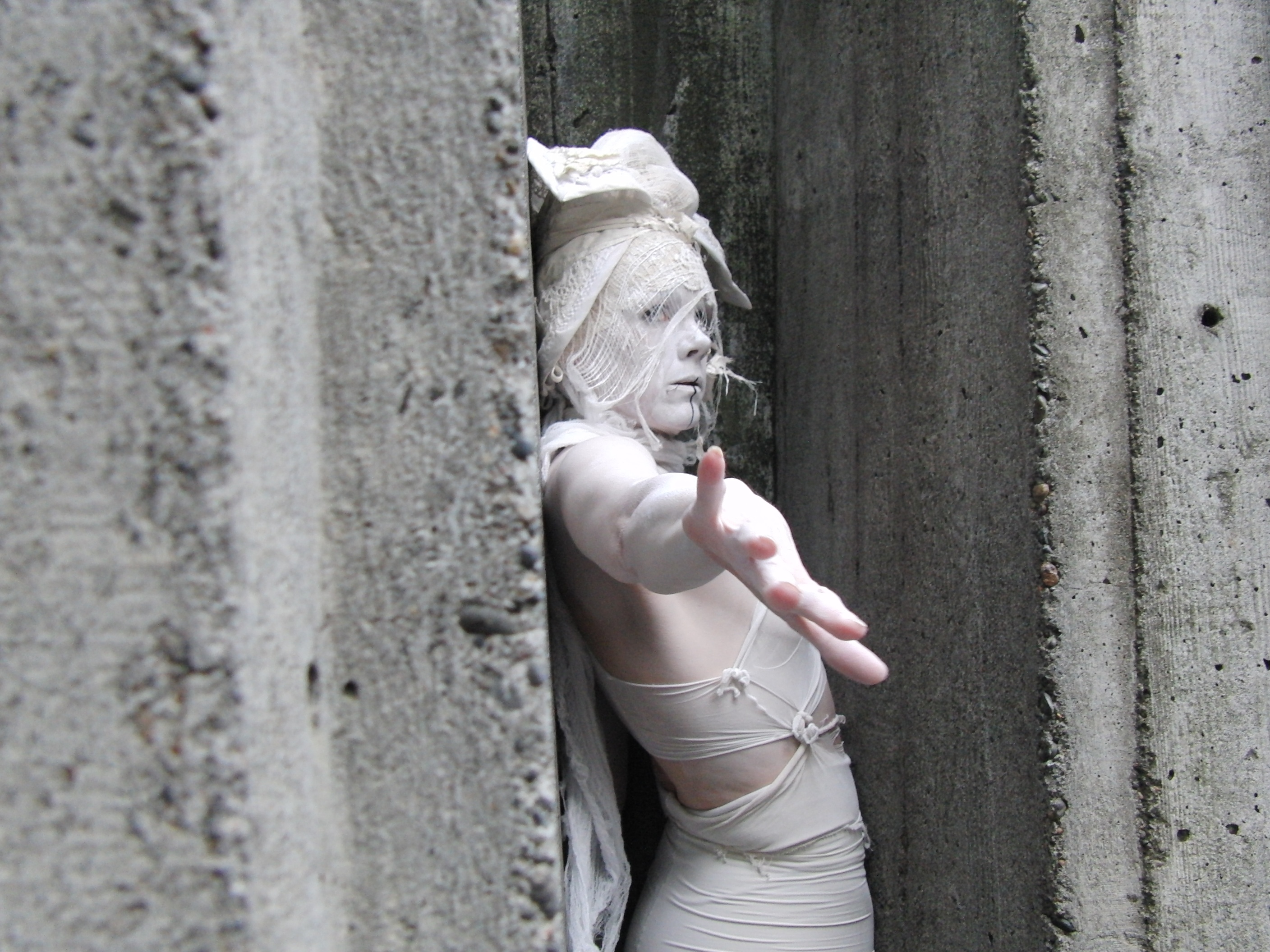
Soaring in the Air, Writhing on the Ground: Bad Unkl Sista’s “First Breath, Last Breath” for Zyzzyva

Anastazia Louise. photo by F’kir Eldercake

I could tell the performance I was about to witness late last month was extraordinary even before entering the auditorium, just from watching the audience trickle into Z Space in San Francisco. There was a man who had somehow fused his beard with a slinky-like spiral pipe and wrapped it around his neck like a scarf. There were a few women in Betty Page/rockabilly outfits and the attendant shellacked beehive and Winehouse eyeliner. One girl’s hair resembled a Pantone swatch sheet—literally—small squares of dye checkered her shoulder-length crop. One man, who we found out later was the set designer for the production, had sausage links hanging from his belt loops. There were leather and piles of silver, feathers and dreadlocks, tattoos and guy-liner. I’ve never felt like such a square; even before the performance began it had rendered my life meaningless.

As a prelude to Bad Unkl Sista’s latest production, “First Breath, Last Breath,” the performers proceeded into the lobby—slowly, staring at the audience, making gong noises on obscure instruments—before moving into the proscenium theater space. The procession gave the audience something the performance could not. Up close we could see the magnificently bizarre costumes devised by artistic director, choreographer, and soloist Anastazia Louise. It was a head-scratching amalgam of Victoriana, Burning Man, and Steampunk: gas masks, fishbowl mouthpieces, hoop skirts of shredded denim, toreador and Japanese hakama pants, Puritan bonnets, and of course the signature white full-body paint of Butoh.

What we could also see better in the procession than from the stage were the facial expressions of the performers (although they were by no means unreadable from the distance). These expressions reflect an integral characteristic of Butoh, which rejects the dictate of traditional showmanship that a performer must put his “best face” forward. Butoh revels in death and the grotesque aspects of living. The performers walked shivering and hunched over, their eyes rolled back, jaws hanging open and tongues dangling, heads lolling to the side, hands trembling. This overture was particularly powerful when one realized how seldom we witness the human body in this condition: only in the presence of someone very sick, damaged, or deranged. (continue reading)

Posted in ART, butoh, damn good, dance, REVIEWS, San Francisco, theatre | Tagged , , , , , , | Leave a comment