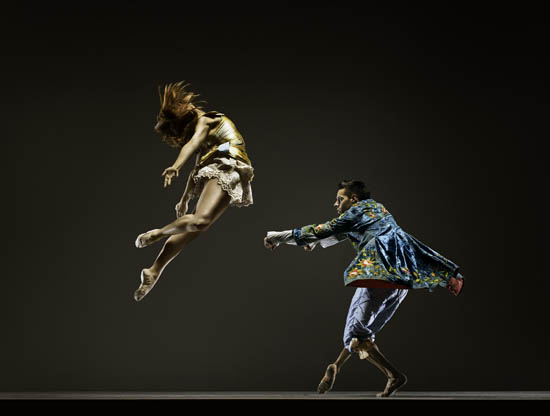
and after seeing Robert Moses’ Kin…

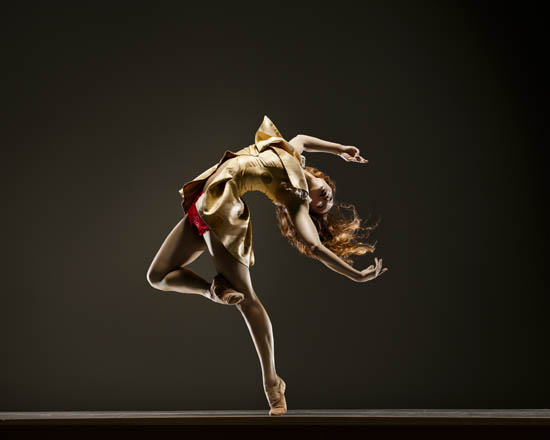
photo by RJ Muna

What an amazing company! Not sure why Yerba Buena Center’s Novellus Theater wasn’t full. This was as interesting as anything going on in dance right now in the Bay Area and possibly beyond.

My favorite piece was the first: The Soft Sweet Smell of Firm Warm Things, set to a hypnotic synth score that changed midway-through into heavy cinematic music (think ’60’s era Bond). The choreography didn’t quite look like anything I’ve seen, way more casual and genderless than ballet, fiercer and more “street” than a lot of modern dance, yet sharper, more taut and with a higher center of gravity than street. It conveyed a generalized aggro that was sort of scary and fascinating, and at times, beautiful. I don’t know what it had to do with the title, but wonder if the women’s costumes in different shades of labial pink and the men’s blueball-colored pants signified anything (besides my own dirty imagination).

Also excellent was “Speaking Ill of the Dead”: It was less powerful at the beginning, when it seemed the dancers were portraying war itself, or soldiers, or something–pumping their fists, staring fearsomely, marching heavily in their bare feet and acting generally tough (but looking more like lithe modern dancers attempting to look tough). Though it began by depicting what looked like some outsider’s idea of war, it seemed to morph into a portrayal of the effects of war on people left behind. Dancers flailed their arms and threw themselves on each other, tumbled over each other’s bodies, and struck themselves as a monotone voiceover chanted official condolences for the loss of life. These eventually became condolences for the loss of dignity, of country, and of the future. The flailing about onstage seemed like a physicalization 0f the guilt and confusion of a country that only realized in retrospect the horror it had allowed itself to get into once it was too late to turn back, and the damage was done, both to human life and to the morale of those witness.

“Biography” was also interesting, and I have no idea how the dancers kept time; the “score” was actually a recorded roundtable discussion with James Baldwin, Lorraine Hansberry, Langston Hughes, Emile Capouya, and Alfred Kazin, on black perceptions of the American setting in art. I admit I didn’t perceive the connection between most of the movement and the words that formed the soundtrack (except for one moment when Baldwin (I think?) remarked on the “black man” as being a “corpse”-like presence in American art and literature regardless of whether the subject matter dealt with the black experience or not. Here two of the male dancers, arms outstretched  and curved like wings, nuzzled the necks of two other dancers lying prone on the floor, in what looked like a tableau of vultures scavenging the meat off dead bodies). The discussion itself included ruminations on art and commerce as well as art and race in a manner that could probably be repeated word for word today and be just as relevant. And have you ever heard Lorraine Hansberry’s voice? She speaks like a queen, and her crisp consonants, softened (but not British) “r”s  and liquid vowels made me feel like a valley slob with a bloated tongue.

Anyway, next time Robert Moses’ Kin performs GO SEE THEM. I’ll be there!

Posted in ART, damn good, REVIEWS, San Francisco | Tagged , , , , | 2 Comments

Alvin Ailey American Dance Theater, for Zyzzyva

Alvin Ailey American Dance Theater in Alvin Ailey's Revelations. Photo by Manny Hernandez

The experience of attending an Alvin Ailey American Dance Theater performance is slightly different from that of most other dance company productions. The audience is more diverse both in age and race, and often treats the performance not as a spectacle to sit still and watch in reverent silence, but as a series of invitations and provocations, a sort of call-and-response with movements and shouts, spontaneous applause, and whistling. That was true the first time I saw them perform at New York’s venerable City Center, and even more so earlier this month at Zellerbach Hall, as part of the Cal Performances season. Even before the performance started, there was a buzz in the air—a joviality in the ticket line and loquaciousness among the already-seated that usually only precedes the performance of a particularly famous dancer, a Carlos Acosta or Sylvie Guillem. (continue reading)

Posted in ART, damn good, REVIEWS, San Francisco | Tagged , , , | 7 Comments

The Cult of Beauty: Victorian Avant-Garde at the Legion of Honor, for Art Practical

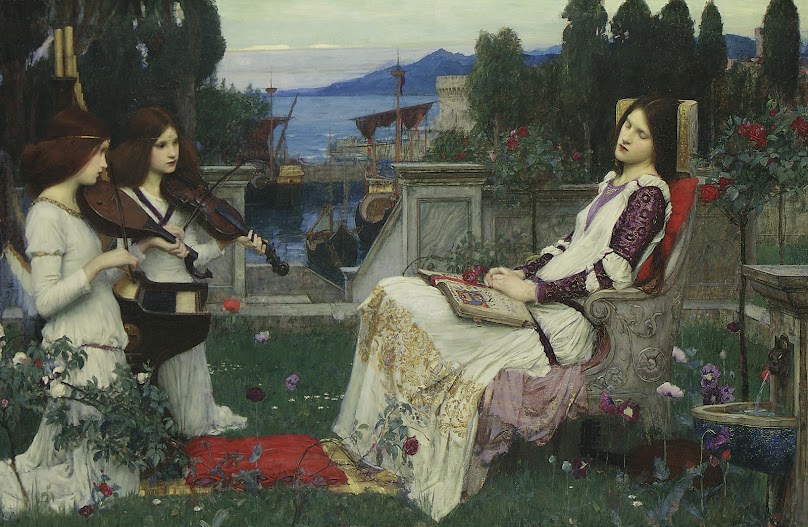
Saint Cecilia, Waterhouse

The temptation to sigh and swoon through The Cult of Beauty: The Victorian Avant-Garde, 18601900, at the Legion of Honor, is strong. The mostly male artists gathered here have borrowed the French poet Charles Baudelaire’s concept of “Art for art’s sake,” producing art whose primary aim was formal beauty. It’s equally tempting to dismiss the Aesthetic Movement in England, of which they were a part, as a moment of escapism before the cultural and political tumults Britain endured throughout the twentieth century. But it’s hard to bemoan the absence of moral, religious, and ethical themes in the works of Dante Gabriel Rossetti, James McNeill Whistler, John William Waterhouse, Edward Burne-Jones, William Morris, and Aubrey Beardsley. Their veneration of beauty as the primary, or even exclusive, concern of art is surprisingly seductive.

The Cult of Beauty focuses on the movement’s contributions to both the decorative arts and the “fine” ones (not that these champions of the aesthetic would have necessarily differentiated between the two categories). By applying their blinkered obsession to every facet of their lives, these artists created the first incarnation of what we might describe today as lifestyle porn, designing furniture, wallpaper, ceramics, textiles, and more. Several installation walls are papered in modern reproductions of William Morris or Edward Godwin designs: elaborate patterns involving swans, peacock feathers, and flowers in rich, liberally gilded earth tones. These wallpapers refute the accepted minimalist wisdom that less is more when it comes to interior decor. Though rich with motifs and bold colors, they are not cluttered or noisy, offering proof that a room’s visual harmony can be enhanced, rather than jeopardized, by complicated design elements and patterns. Building on the achievements of the celebrated Victorian gift book binders, the artists of the Aesthetic Movement also experimented with print, emphasizing beauty in the typography, cover design, paper, presswork, and illustrations of their books. (continue reading)

Posted in ART, damn good, REVIEWS, San Francisco | Tagged , , , , , , , | Leave a comment

I’m seeing Robert Moses’ Kin this week end. HuffPost.

photo by RJ Muna

Weekends are short and the list of culturally enriching events is long. With all the concerts, readings, exhibits and shows going on, how do you decide what to fit into your all-too-brief respite from the workweek? Well, attending a performance by Robert Moses’ Kin is like packing several artistic forays into one evening. Known since 1995 for blending diverse traditions in dance — including African, street, classical ballet and his own distinct choreographic motifs — as well as combining music, dialogue, poetry and video installations for his pieces, Moses creates works with emphatically political and social messages. Having addressed issues like the changing paradigm of the American family, racial prejudice, sexual intolerance and the sometimes tense disparities in the public and private lives of American icons, RBK continues in this vein of artistic and ideological inquiry in its newest production. (continue reading)

Posted in ART, dance, San Francisco | Tagged , , , , , | Leave a comment

Trio, Francesca da Rimini, and Carnaval des Animaux at SF Ballet for Zyzzyva

photo by Erik Tomasson

Helgi Tomasson, the San Francisco Ballet’s artistic director and principal choreographer, combined elements of modern and classical ballet to create “Trio,” set to Tchaikovsky’s Souvenir de Florence. While much of the ballet recalls the aggrandized ballroom prancing one sees so often, softened arm positions and unusual footwork modernized the movements. The women’s richly autumnal-colored dresses, though shaped like a slightly less stiff version of the lampshade skirt (ballet’s frumpiest costume), were slit to the hip, and allowed a leg to swing out in many steps and kept the piece from looking as primly traditional as it might have otherwise. But while the first and third movement of “Trio” seemed trapped in a sort of generalized exuberance, the middle piece offered a heartbreaking, and ambiguous, drama.

The program notes describe the pas de deux (which turned into a pas de trois) as “lovers and death,” but I admit I had a less allegorical interpretation: the lovers and the cold, controlling husband. The lovers’ pas de deux was delicate and sensuous, and somehow maintained these qualities even after the intrusion of the third character added desperation and struggle to the combination. Dana Genshaft’s acting abilities helped, alternately evoking tenderness and fear as she was passed back and forth between the two men battling for possession of her. (continue reading)

Posted in ART, ballet, dance, REVIEWS, San Francisco | Tagged , , , , | 2 Comments

Chroma, Beaux, and Number Nine at SF Ballet, for Zyzzyva

Yuan Yuan Tan and Taras Domitro in McGregor's Chroma. © Erik Tomasson

The San Francisco Ballet’s Program 2, which finished its run late last month, started strong. Wayne McGregor’s “Chroma” — one of three works making up the program — looked more like contact sport than ballet, an effect strengthened by the horn-and percussive-heavy, action-film score by Joby Talbot and Jack White III. MacGregor was not trained in classical ballet, and his choreography diverges from the classical in several refreshing ways. Ballet’s traditional “lift”—the illusion that the dancers do not share our subjection to the laws of gravity—was tossed out. The dancers seemed to revel in their weightiness, often moving in ways emphasizing horizontal rather than vertical lines. Pas de deux resembled the alternately combative and aggressive sexual grappling between equally powerful forces, rather than the stylized chivalry of the traditional male-female duets. It was exciting and sometimes scary, and the only bad call was the costuming—loose mini bandeaux in flesh tones that obscured the dancers’ waistlines and gave the impression they were wrapped in giant dental dams. (continue reading)

Posted in ART, ballet, REVIEWS, San Francisco | Tagged , , , , , , , , | 1 Comment

I interviewed photographer Fred Lyon for The Rumpus

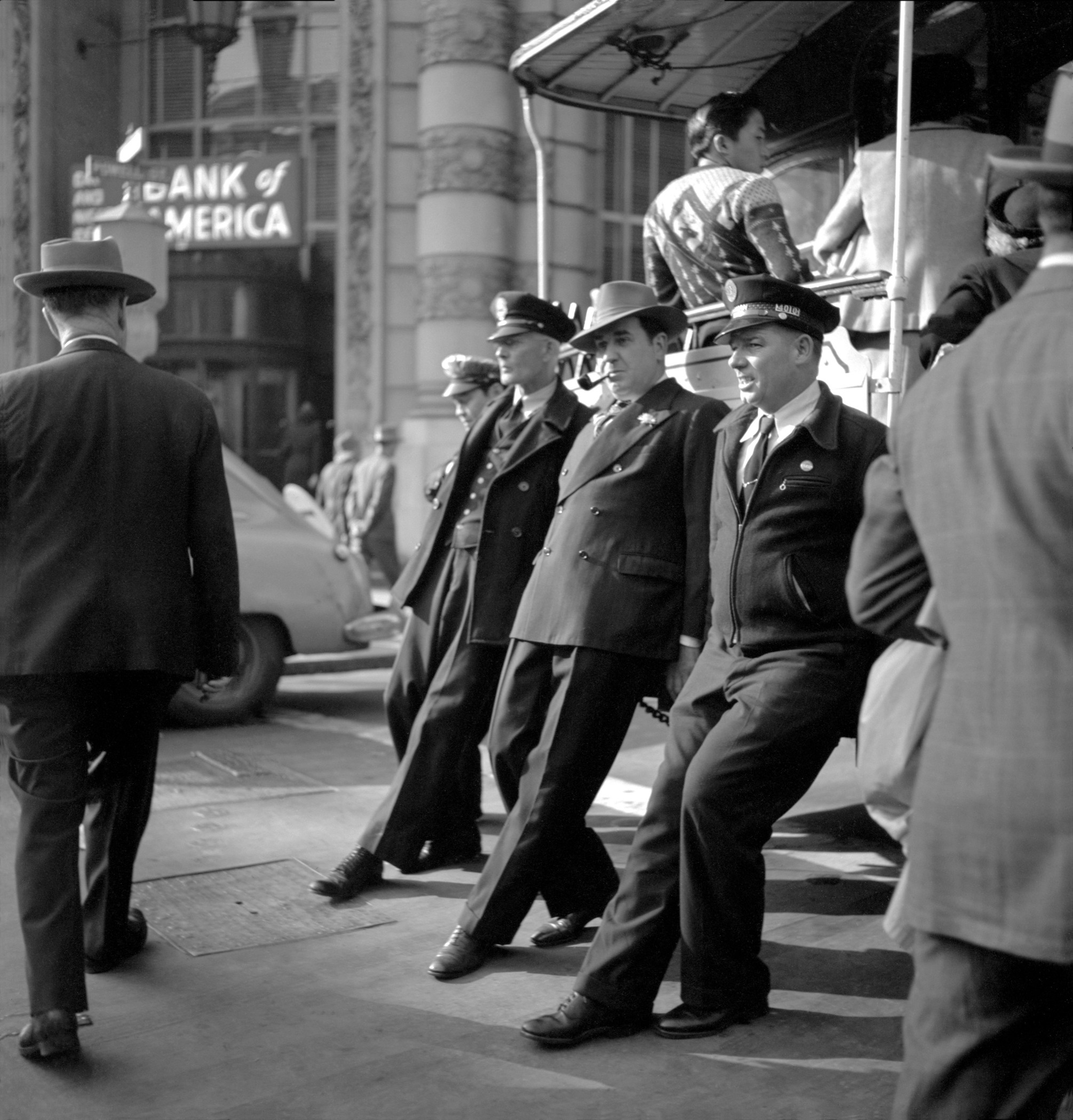
What does it take to commit to a craft for more than 70 years—particularly one that has undergone the revolutions in technology that photography has? Legendary photographer Fred Lyon worked as a Navy photographer in WWII, spent more than a decade in advertizing and fashion in New York, shot journalistically for Lifemagazine and Sports Illustrated, and returned to his native Bay Area to document the city and further diversify his repertoire. I sat down with the gracious, funny, and formidably energetic Lyon to discuss the habits of attitude, practice, and perseverance that have given his career such longevity.

The Rumpus: I’m curious about how peoples’ reading of photography, both art- and journalistic, has changed with the glut of images we see every day, in social networks, etc. When you started out, and photographs were more rare, do you think people looked at them differently?

Fred Lyon: It’s one of the funny things about living as long as I have, you don’t see it happening; it just happens, and only in retrospect do you see the wild changes. For many years, if I was working on something journalistic, if I raised my camera, people were a little shocked and wanted to know what I was doing. I had to be very quick to get what I wanted before they said, “Why are you pointing that machine at me?!” Now it’s so much better. Nobody cares if they’re having their pictures taken. Young people just have photography as part of their vocabulary. It’s the language of young people. All of you just use it as a tool without being impressed by it. As for art, I’ve always gotten nervous around people who talk about “fine art photography.” Usually, it’s named that by the people who are doing it. My feeling is that if it’s fine art, somebody else will tell you. I just photograph what I see or what I visualize and if somebody else thinks that’s art, terrific. (Continue reading)

Posted in ART, damn good, Interviews, photography, San Francisco | Tagged , , , , , | 3 Comments

Speak, Memory: Restaging the Past in Todd Hido’s Silver Meadows

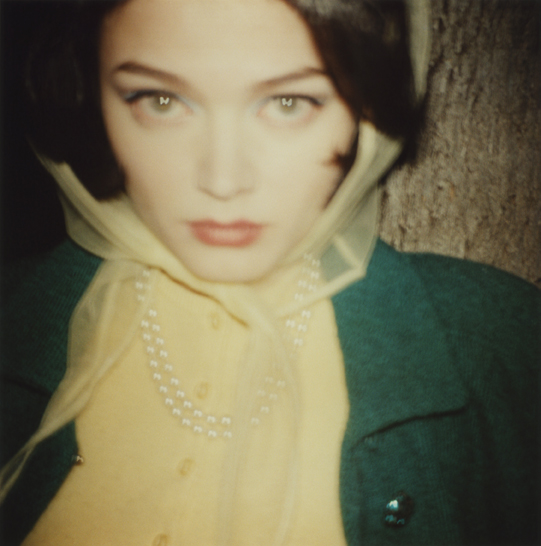
The press release for Todd Hido’s recent exhibit Excerpts from Silver Meadows describes it as a “metaphorical reckoning with his own past,” and indeed many of images look as they might in memory or old polaroids: blurry, the colors faded or over-saturated or yellowing, and darkening towards the edges. Hido even sets up many of the shots to replicate how these scenes would have been experienced in the most mundane moments, shooting houses from the vantage point of the driveway, or perhaps the neighbor’s driveway, through frosted, clouded, or rain-spattered car windows. He manages to find rich colors in scenes most would dismiss as “gray”: snow might have a rosy tone, an overcast sky edges toward purple. His outdoor scenes comprise a sort of anti-Kinkadian vision of the midwestern Anytown — their very imperfections, both haphazard and contrived, create an atmosphere that has mood without nostalgic sentimentality, darkly beautiful and quiet and grim.

Hido’s photographs of women, however, imply that the shabby trailers and tract houses standing in the gloom with their lights shining through the windows (a recurrent Hido motif) are not a simple reflection of atmosphere but in fact a concealment of the human turmoil within their homes. One cannot look at these deceptively banal settings in the same way after seeing their presumed inhabitants. Hido seems to have created three characters out of the real or mythologized women of his memory and imagination: the melancholic teenager, the “desperate housewife,” and the Marilynesque sexpot. They exude different kinds of sexual availability, but all seem wounded, both physically and spiritually. A young naked girl slouches on the floor next to a bed, her face expressionless. She seems as blasé about her own nudity (and its implied purpose) as about the unexplained fresh scars on her breast and ribs. A seemingly conventional adult woman–pearls, perm, and perfectly-lined eyes — stands in a completely unbuttoned cardigan, leaning forward slightly as if to encourage her breasts to spill out of her strapless bra. Her face looks drawn, on the verge of tears. She is sexually challenging — or beseeching — and she recalls the housewives Betty Friedan wrote about in The Feminine Mystique, who sought to assuage their dissatisfaction with the narrow domestic life to which they were consigned by a desperate and almost predatory sexual adventurousness outside their own households. (continue reading at photo mag and review Fraction Magazine, or with a slideshow on the Huffington Post)

Posted in ART, photography, REVIEWS, San Francisco | Tagged , , , , , | 2 Comments

I chatted with artist Michael Brennan for Zyzzyva.

If you’ve dined at any number of swanky Bay Area establishments, you might have unwittingly enjoyed your meal in a restaurant designed by one of the few people who is as well known and well respected for his fine art as for his commercial work. Michael Brennan has designed the interiors of such San Francisco hotspots as Farallon, Zero Zero, Fleur de Lys, and Bruno’s, and Alameda’s Miss Pearl’s Jam House, as well as Revival in Berkeley. He’s painted murals for many more places, too, including the Cliff House (also in San Francisco).

ZYZZYVA’s Winter ’11 issue features images of some of Brennan’s smaller-scale works. For these paintings, he often chooses as his subject small figurines and children’s toys. Brennan magnifies them in both scale and import, revealing affection for the mementos of childhood, but without sentimentalizing them or glossing over the sometimes-sinister tone these objects assume when considered out of context. Coating them in oil to add sheen, Brennan casts these toys and figures against abstract or ambiguous backgrounds, rendering them in near photographic realism. The results can alternate between the playful and the nightmarish, and recall the feeling of certainty nearly every child has that his toys “come to life” when no one’s looking. We talked with him about his work at his SOMA studio in San Francisco. (continue reading)

Posted in ART, Interviews, painting, San Francisco | Tagged , , , , , , | Leave a comment

Masked Ball, Venetian Masters, and trippy mashups at the de Young, Zyzzyva

Gerhard Richter’s enormous mural Strontium glowered over Wilsey Court. The mural, made from a collection of blurred photographs representing the atomic structure of strontium titanate (a substance used to make artificial diamonds), might have been interpreted as a bit of a symbolic downer on the festivities, which celebrated both the high and the low fruits of early-Renaissance wealth. Projected on an adjacent wall was the flashier and less demanding 1964 Vincent Price horror flick, Masque of the Red Death. Downstairs, the lauded exhibition, “Masters of Venice: Renaissance Painters of Passion and Power” was open to any partygoer who wanted to view it, and at any other time that might have been more tempting, especially considering these were its last days in San Francisco. After all, how often can one see Titians, Tintorettos, Giorgiones, and Veroneses in this hemisphere? But the people who came out for the masked ball at the De Young that night seemed reluctant to defer to any artwork other than that which they had made of themselves. People concocted different “fancy dress” iterations of the past 400 years, and wore or even painted on elaborate carnival masks, a combination that evoked the formal glamour of opening night at the opera with the DIY exuberance of Halloween. There were tables holding different kinds of brie and bars serving pink and orange drinks with edible flowers and blood orange slices. Caterers with trays of mini tiramisus dodged patrons whose peripheral vision was mask-obscured; there was a lot of “Pardon me,” “oops, so sorry,” and “oh dear, can I get you another one of those?” that night. (continue reading)

Posted in damn good, EVENTS, Music, REVIEWS, San Francisco | Tagged , , , , , , , | 2 Comments